

A vacant Austin property represents lost income. The wrong tenant represents a direct threat to your investment. The critical difference between a secure asset and a financial liability is the quality of your screening process. An incomplete or non-compliant Austin tenant credit check exposes you to months of unpaid rent, costly damages, and serious legal risks, including Fair Housing violations. You cannot afford to make a mistake.
This definitive 2026 guide provides the actionable intelligence you need. Learn the correct, legal procedure for obtaining comprehensive credit reports. Understand how to interpret an applicant’s financial history and identify the red flags that truly matter in today’s rental market. Our nationwide background check services empower you to protect your property with a documented, defensible, and fully compliant screening process. Get the verified data required to make a secure and confident decision.
Key Takeaways
- Learn why a standard credit score is insufficient for evaluating applicants in Austin’s high-demand rental market.
- Discover which sections of a credit report reveal an applicant’s true financial stability beyond just the numbers.
- Protect your investment from legal risk by establishing clear, written rental criteria before you screen applicants.
- Get the exact steps to perform a fast, compliant Austin tenant credit check and make a confident leasing decision.
Why a Basic Credit Score Isn’t Enough in Austin’s Market
In competitive rental markets nationwide, landlords must make fast, accurate decisions. Austin is a prime example of this high-stakes environment, where intense demand and soaring rents mean a single vacancy represents a significant financial loss. In this climate, relying on a three-digit credit score is a critical error. A true tenant credit check is not a number; it is a comprehensive report detailing an applicant’s verified financial behavior.
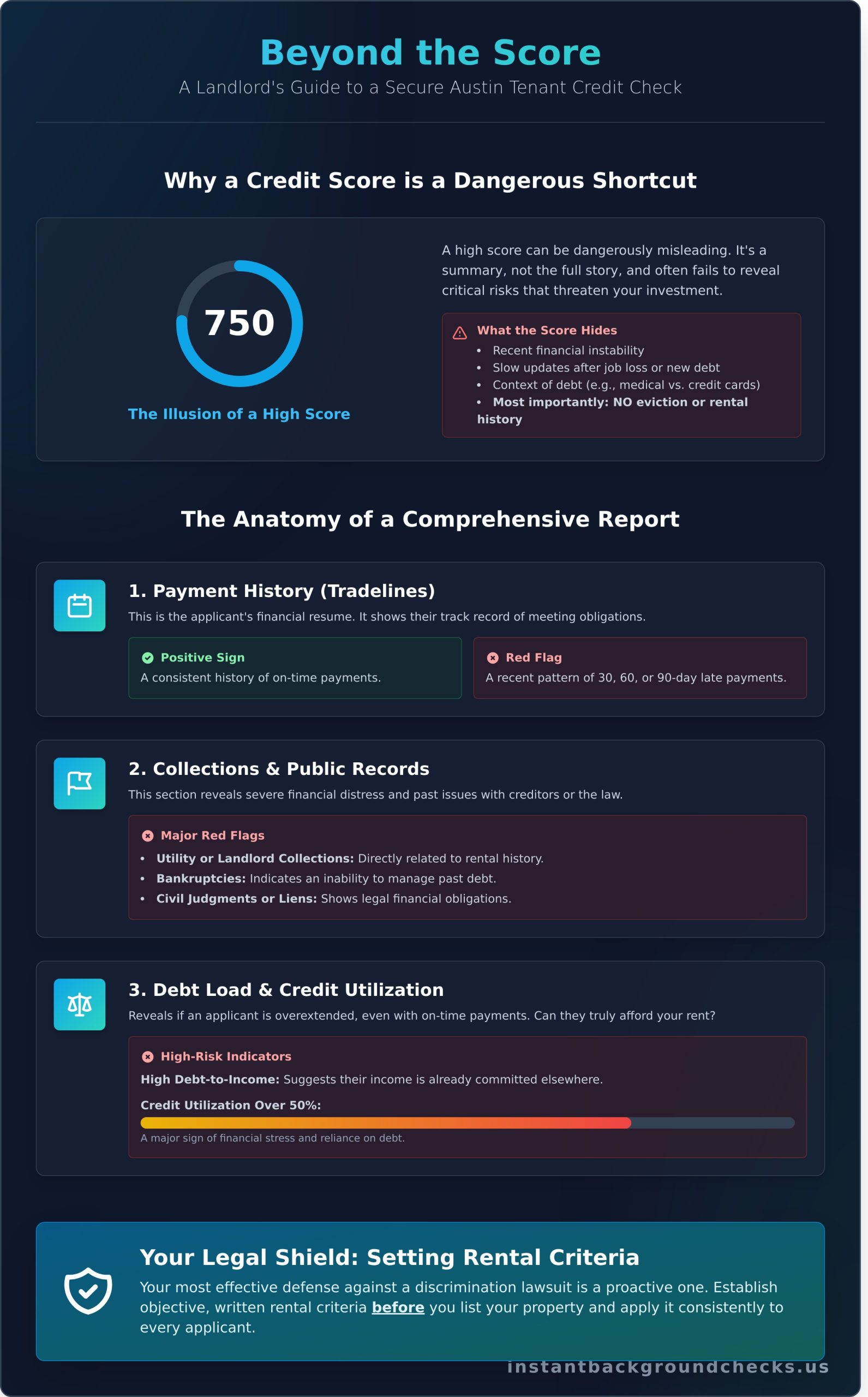
A high score can be dangerously misleading. It often masks recent financial instability-like a sudden job loss or mounting debt that has not yet registered on the report. An applicant with a 750 score might look perfect on paper but could be weeks away from default. To protect your investment, you need the full story. A complete Austin tenant credit check provides the critical context required to assess an applicant’s true risk profile, a necessity for property owners across the country.
The Limitations of a Three-Digit Score
A credit score is a summary, not a detailed analysis. It is an algorithm-generated number that cannot distinguish between different types of debt, such as manageable medical bills versus maxed-out credit cards. Furthermore, scores are often slow to update after major financial events. Most importantly, standard credit scores do not include eviction histories or previous rental payment records-the most relevant data for any landlord.
What a Comprehensive Report Reveals
A detailed screening report moves beyond the score to provide actionable intelligence. This level of detail is a core component of a compliant tenant screening process and delivers the full narrative behind the numbers. A proper report includes:
- Payment History: A clear record of on-time payments, delinquencies, and accounts in collections.
- Total Debt Load: An overview of all outstanding debts, offering insight into an applicant’s financial obligations.
- Credit Inquiries: A pattern of recent applications for new credit can signal financial distress.
- Public Records: Verified information on bankruptcies, liens, or civil judgments.
This data tells a clear story about financial responsibility. Accessing a detailed, FCRA-compliant report is the only way to make a secure leasing decision.
Deconstructing the Tenant Credit Report: Key Sections to Analyze
Think of a credit report as an applicant’s financial resume. It provides a verified history of their financial responsibility, offering a far more detailed picture than a simple credit score. A successful Austin tenant credit check requires looking for patterns of behavior, not just isolated data points. Your goal is to assess risk and predict future payment reliability. Our service provides these comprehensive, confidential reports for landlords across the U.S., giving you the data needed to make an informed decision. Focus your analysis on these four critical areas.
Payment History (Tradelines)
Tradelines are the individual credit accounts listed on a report, such as credit cards, auto loans, or mortgages. This section is the core of the financial resume. You are looking for a consistent history of on-time payments. A single late payment from five years ago is insignificant, but a recent pattern of 30, 60, or 90-day late payments is a major warning sign. Consistent, timely payments demonstrate reliability and financial stability.
Collections and Public Records
This section often contains the most significant red flags for landlords. A collection account means a creditor has written off a debt and sold it to a collection agency. Pay special attention to collections from utility companies or previous landlords, as this directly relates to their rental history. Public records will list bankruptcies or civil judgments, which signal severe financial distress and can directly impact their ability to fulfill a lease agreement.
Debt-to-Income and Credit Utilization
This data reveals an applicant’s current financial burden. A high total debt load, even with on-time payments, can indicate they are overextended. Credit utilization-the percentage of available credit they are using-is another key indicator. High utilization (over 50%) suggests financial stress. This is critical when considering an applicant’s ability to afford rent, especially since the Austin’s housing market demands a significant portion of a renter’s income. An effective Austin tenant credit check matches their debt obligations against your property’s rent to verify affordability.
Setting Your Rental Criteria: A Legal Framework for Fair Screening
The primary concern for any landlord is a discrimination lawsuit. The most effective defense is a proactive one: establish objective, written rental criteria before you list your property. This ensures every applicant is measured against the same non-discriminatory standards, a core requirement of the Fair Housing Act. In fact, Texas law requires landlords to provide this information upon request, as outlined in the Texas Property Code on Tenant Selection Criteria. A consistent process is your best protection.
Establishing Minimum Credit Standards
Your criteria must be specific and measurable. Vague rules invite inconsistency and potential claims of bias. Define your minimum financial requirements clearly. Consider standards such as:
- A minimum credit score, applied uniformly to all applicants.
- No active collections accounts from prior landlords or utility companies.
- No eviction filings within the last 5-7 years.
- A verifiable income of at least 2.5x or 3x the monthly rent.
For applicants with no credit history (a ‘thin file’), you cannot automatically deny them. Instead, your policy should allow for alternative proof of financial responsibility, like verified bank statements or a positive rental history.
Complying with the Fair Credit Reporting Act (FCRA)
When you run an Austin tenant credit check, you become a user of consumer reports and must comply with the federal FCRA. This involves three critical steps. First, you must obtain written permission from the applicant. Second, you must have a legally permissible purpose, which screening a tenant is. Finally, if you deny an applicant based on information in their report, you must issue an ‘adverse action notice.’ This letter informs them of the denial, identifies the credit reporting agency used, and explains their right to a free copy of the report.
What You Can’t Consider in Austin
Austin landlords must navigate both federal and local regulations. The City of Austin has ordinances protecting tenants based on their ‘source of income,’ meaning you cannot reject an applicant solely because they use a housing voucher or other rental assistance. Your screening process for an Austin tenant credit check must always focus on financial behavior and qualifications, never on an applicant’s protected class status. A compliant screening service is essential for navigating these rules. Get a compliant credit check that gives you only the data you need.
Interpreting Red Flags in the Context of Austin’s Economy
A credit report is a collection of data points, not a final judgment. In a competitive market like Austin, perfect financial records are rare. The key is not to find a flawless applicant but to accurately assess risk. A comprehensive Austin tenant credit check provides the raw data; your expertise is required to interpret it within the local economic context. This process moves you from theory to a defensible, real-world leasing decision.
Major vs. Minor Red Flags
Not all negative items carry the same weight. Your evaluation must be systematic and prioritize issues directly related to a tenant’s ability to fulfill a lease agreement. Differentiate between high-risk and lower-risk indicators to make a clear-headed assessment.
- High-Risk (Direct Indicators): An eviction history is the most critical red flag. It demonstrates a legal failure to meet rental obligations. Collections from utility companies or previous landlords also signal significant risk, as they are directly tied to housing stability.
- Lower-Risk (Context is Key): Medical debt, especially in the U.S., is often unavoidable and less indicative of financial irresponsibility. Similarly, old student loan delinquencies may be less relevant than recent, consistent payment history on other accounts. Always consider the age and amount of a collection; a small, five-year-old medical bill is fundamentally different from a large, recent utility write-off.
Considering the Bigger Picture
The credit report is only one component of your screening process. An effective landlord never makes a decision based on a single piece of information. Instead, you must synthesize all available data to form a complete applicant profile. A lower credit score can be mitigated by other strong qualifications.
Cross-reference the credit report with verified income and employment history. An applicant with a stable, well-paying job in Austin’s robust tech or healthcare sectors may be a reliable tenant despite past credit issues. Positive references from previous landlords are powerful validators. Your goal is to build a holistic view that supports an informed, confident, and legally compliant leasing decision. For a complete and accurate picture, get the data you need from a trusted nationwide background check provider.
How to Get an Instant & Compliant Austin Tenant Credit Check
You understand the laws, the risks, and the criteria for a reliable tenant. Now it is time to act. Executing a compliant Austin tenant credit check doesn’t have to be complicated or slow. With InstantBackgroundChecks.us, you get a direct, secure, and immediate solution designed for landlords who value accuracy and speed.
Our platform provides comprehensive, nationwide background check services. There are no subscriptions and no monthly fees-just a straightforward pay-per-report model that puts you in complete control. The process is simple and built to protect your investment.
Step 1: Get Applicant Consent
Compliance is mandatory. Before you can access any private data, federal law (FCRA) requires you to obtain explicit, written consent from your applicant. This is the critical first step in a legally sound screening process. Our secure platform facilitates this authorization, creating a clear and compliant record before you proceed.
Step 2: Choose Your Screening Package
A credit score is only one piece of the puzzle. For a complete risk assessment, you need more. Our standard tenant screening package combines three essential reports into one comprehensive file:
- Credit Report: Reveals debt load, payment history, and financial stability.
- Nationwide Criminal History: Uncovers relevant convictions that could signal a risk to your property or community.
- Eviction History: Shows past landlord-tenant disputes and court-ordered removals.
This combined data provides the intelligence you need. Our pay-per-use model is perfect for independent landlords who need professional-grade tools without the cost of a subscription.
Step 3: Receive and Review the Instant Report
Waiting for information creates risk and delays. Our system delivers verified reports instantly. Once you receive the file, apply your pre-established rental criteria fairly and consistently to every applicant. The data is clear, concise, and ready for your review. Make your decision with confidence, backed by official public records. Do not leave your property’s security to chance.
Protect your investment. Run your Austin tenant credit check now.
Secure Your Investment: The Final Step in Tenant Screening
In Austin’s dynamic rental landscape, a simple credit score is not enough to mitigate risk. The key to securing a reliable tenant lies in a comprehensive evaluation of their full financial history and establishing clear, legally compliant rental criteria before you begin. This detailed approach moves you beyond guesswork and into data-driven decision-making, protecting your property for the long term.
An official Austin tenant credit check is your most powerful tool in this process. Instant Background Checks provides the accurate, in-depth reports you need to verify an applicant’s financial responsibility instantly. As a nationwide provider serving landlords since 1982, we deliver fully FCRA-compliant data you can trust, with no hidden monthly or annual fees. Take control of your screening process with verified information.
Don’t wait for uncertainty to become a liability. Order Your Instant Austin Tenant Screening Report Now and make your next lease decision with absolute confidence.
Frequently Asked Questions
What credit score do you need to rent an apartment in Austin?
There is no official minimum credit score required to rent in Austin. However, most landlords and property managers prefer applicants with a score of 620 or higher. A competitive rental market may demand an even higher score. Applicants with lower scores are not automatically disqualified but may be required to pay a larger security deposit, find a co-signer, or provide proof of a substantial income to mitigate the perceived risk for the landlord.
Can a landlord in Texas deny an applicant for bad credit?
Yes. In Texas, a landlord can legally deny a rental application based on poor credit history, provided this standard is applied consistently to all applicants. The denial must be based on legitimate business criteria established by the landlord. If you deny an applicant due to information found in their credit report, you are legally required by the Fair Credit Reporting Act (FCRA) to provide them with an adverse action notice explaining the decision.
What shows up on a tenant credit check for a rental in Austin?
A standard Austin tenant credit check provides a detailed financial summary. This report includes the applicant’s credit score, a history of payments on loans and credit cards, current debt levels, and public records like bankruptcies or liens. It verifies the applicant’s identity and reveals their track record of financial responsibility. This data is critical for assessing an applicant’s ability to pay rent consistently and on time, protecting your investment.
How long does a tenant credit check take?
Modern screening services deliver results almost instantly. With an applicant’s consent and required information, you can access a comprehensive credit report in minutes. This speed is a significant advantage over outdated, manual methods that could take several days to complete. Instant access allows you to make fast, informed leasing decisions and secure qualified tenants before they look elsewhere in Austin’s competitive market, minimizing vacancy periods for your property.
Do I need the applicant’s Social Security Number to run a credit check?
Yes, a Social Security Number (SSN) is essential for an accurate credit check. The major credit bureaus-Equifax, Experian, and TransUnion-use the SSN as the primary identifier to locate and verify an individual’s credit file. To comply with the FCRA, you must obtain explicit written consent from the applicant before you can run any type of background or credit check. This protects both you and the applicant during the screening process.
What is an ‘adverse action notice’ and when do I need to send one?
An adverse action notice is a formal letter required by the FCRA. You must send this notice to an applicant if you take any negative action based on their consumer report. This includes denying their application, requiring a co-signer, or charging a higher security deposit. The notice must identify the credit reporting agency that supplied the report and inform the applicant of their right to dispute the information and obtain a free copy. For individuals seeking to understand and improve their financial standing after receiving such a notice, professional consulting from firms like Allen & Allen, Inc. can offer a clear path forward.
Is it legal for a landlord to charge an application fee for a credit check in Texas?
Yes, it is legal in Texas for landlords to charge a non-refundable application fee. This fee is meant to cover the actual costs of the tenant screening process, which includes running the credit check, verifying employment, and performing a background check. The fee amount must be reasonable and should be disclosed to the applicant upfront. It is a standard practice to ensure that only serious applicants proceed with the rental process.
How can I get a credit check that also includes eviction and criminal history?
Use a comprehensive screening service that bundles these reports. Our nationwide background check services provide a complete picture by combining a credit report with a national criminal record search and a detailed eviction history. This integrated approach is the most effective way to vet applicants thoroughly. Get instant, verified results from public records across the U.S. to ensure you have all the critical data needed to make a secure and informed leasing decision.