

A single negligent hiring lawsuit costs a business an average of $1 million. This figure doesn’t account for the legal fees or the irreversible damage to your company’s reputation. The risk is simply too high to ignore.
You already know that screening every candidate is non-negotiable. Yet you’re constantly fighting slow turnaround times that delay critical hires and navigating a maze of compliance rules that change by the day. Many vendors compound the problem, locking you into expensive monthly subscriptions for services you don’t even use.
This guide delivers the solution. Learn how to secure instant, accurate, and fully FCRA-compliant background check services for employers without the burden of recurring fees. In this complete 2026 guide, we provide the definitive process for getting verified reports immediately while ensuring total legal compliance nationwide. You’ll discover how to pay only for what you use and hire with absolute confidence.
Key Takeaways
- Avoid costly subscription traps by understanding the pay-per-report model, which allows you to scale hiring on-demand without fixed monthly fees.
- Master the essential FCRA and EEOC compliance rules to protect your business from legal liability during the pre-employment screening process.
- Identify the non-negotiable components of every employee screening, including comprehensive criminal record and sex offender registry searches.
- Implement a faster hiring process with the right background check services for employers by following a direct, two-step guide to securing instant reports.
What are Background Check Services for Employers?
Professional pre-employment screening is a non-negotiable security protocol for any modern business. In 2026, it’s defined by two factors: speed and accuracy. Fundamentally, what are background check services for employers? They are structured, confidential investigations into a candidate’s history using verified public records to confirm their qualifications and identify potential risks. This process is critically different from consumer “people search” websites, which are not compliant with the Fair Credit Reporting Act (FCRA) and cannot legally be used for hiring decisions.
Consumer sites often pull unverified, outdated information from across the web. Professional services, in contrast, access official, legally permissible databases to deliver accurate, actionable intelligence. For any hiring decision, only data sourced directly from government and courthouse records is reliable. Anything less exposes your company to significant legal and financial liability.
The Role of Public Records in Modern Hiring
Verified public records are the only legally defensible source for hiring. These records are organized in a clear hierarchy: County for recent criminal activity, State for a comprehensive history, and Federal for major offenses like fraud or terrorism. Every professional screen begins with a Social Security Number (SSN) trace to confirm the candidate’s identity. This digital framework allows instant access to archives that once required weeks of manual retrieval.
The evolution from manual to digital has been transformative. The days of dispatching runners to physical courthouses are over. A process that consistently took 10-15 business days in the early 2000s has been compressed by direct database integration. Today, secure access to county court terminals, state repositories, and federal watchlists delivers comprehensive reports in minutes, not weeks. This speed doesn’t compromise accuracy; it enhances it by eliminating human error in data transcription and cross-referencing multiple jurisdictions instantly.
Why Businesses Need Professional Screening
Businesses use professional screening for three critical reasons: protection, liability, and verification. It secures company assets and ensures a safe work environment for all employees. It provides documented due diligence, mitigating the risk of negligent hiring lawsuits where jury awards can exceed $1 million. Finally, it confirms candidate honesty; a 2023 ResumeLab study found that 70% of applicants admit to lying on their resumes. A background check verifies the facts.
Choosing the right background check services for employers is not an administrative task; it is a core business security function. It’s about building a foundation of trust and safety from the very first hire. Using unverified data from a consumer-grade people search site for employment purposes is not just unreliable, it’s a direct violation of federal law. Only an FCRA-compliant, professional service provides the verified intelligence needed to make safe, legal, and confident hiring decisions.
The Subscription Trap: Why Pay-Per-Report is Better for Most Businesses
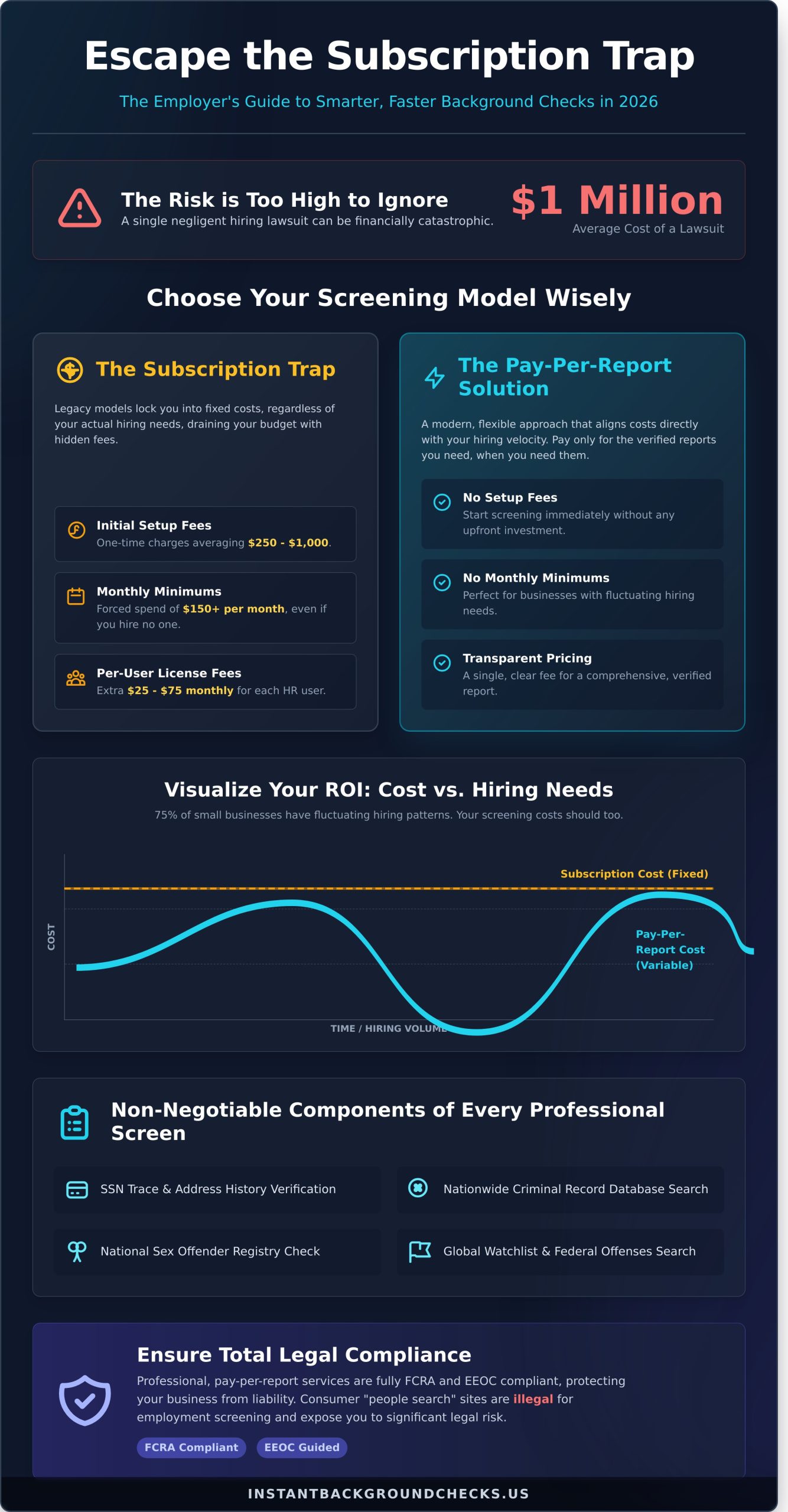
Monthly software contracts create financial drag. For the 75% of small businesses with fluctuating hiring needs, a fixed subscription for background check services for employers is a guaranteed waste of capital. You pay for access you don’t use. The pay-per-report model eliminates this waste. It aligns your screening costs directly with your hiring velocity. You only pay for the specific, verified information you need, exactly when you need it.
This transactional approach empowers businesses to scale with precision. Whether you’re hiring one key executive this quarter or 50 seasonal workers next month, your costs remain proportional to your growth. There are no sunk costs and no monthly penalties for a hiring slowdown.
Subscription Models vs. Transactional Reports
Enterprise-level contracts obscure the true cost of a background check behind a wall of fees. A typical subscription plan from legacy providers in 2025 often includes:
- Initial Setup Fees: A one-time charge averaging $250 to $1,000.
- Monthly Minimums: A required spend of $150 or more, regardless of usage.
- Per-Seat Licenses: An additional $25-$75 monthly fee for each HR user who needs access.
Pay-per-report pricing is transparent. A single fee covers a comprehensive report. What you see is what you get. So-called “unlimited” plans are rarely what they seem; they often restrict access to the most basic data tiers, charging extra for critical checks like MVR reports or federal criminal searches. This forces you into expensive upgrades, defeating the purpose of the flat fee.
Calculating Your ROI on Background Screening
The cost of a bad hire is catastrophic. The U.S. Department of Labor estimates the cost can exceed 30% of the employee’s first-year salary. For a manager earning $80,000, that’s a $24,000 mistake. A comprehensive, instant background check costs less than 0.4% of that potential loss. The return on investment is immediate and substantial.
A bad hire isn’t just about lost productivity; a non-compliant screening process can trigger severe legal penalties. Understanding your legal duties is non-negotiable. For official guidance, consult the government’s resource on Navigating Compliance: FCRA and EEOC Rules to avoid six-figure fines. Using a single, nationwide provider ensures consistent compliance across all 50 states, eliminating the risk and expense of managing multiple regional vendors for your remote workforce.
By 2026, businesses using transactional screening will reduce their average cost-per-hire by an estimated 12% by eliminating software overhead. For companies that hire seasonally or on a project basis, the advantage is even greater. You avoid paying for a dormant account for months at a time. If your business demands this level of financial and operational agility, you can run a single, compliant report today and verify the efficiency for yourself.
The Essential Checklist: What Every Employer Background Check Should Include
A comprehensive background check is not optional. It is a fundamental component of modern risk management. A 2021 report from HR.com revealed that 77% of employers conduct criminal background checks on all job candidates, establishing a clear industry standard. Protecting your assets, employees, and reputation begins with verifying who you hire. A candidate’s application is a claim. Your background check is the verification.
The core of any effective screening process is built on four non-negotiable pillars. These data points provide a baseline for assessing a candidate’s history and verifying their identity. According to industry authority Indeed, The Essential Checklist for any pre-employment screening must confirm these foundational facts to establish a baseline of trust and safety.
- Criminal Searches: This is the absolute foundation. A thorough search queries county, state, and federal databases for felony and misdemeanor convictions. It uncovers critical information that directly impacts workplace safety and security. Don’t settle for a single-source check.
- Sex Offender Registry Searches: This is a non-negotiable safety protocol. Screening against the National Sex Offender Public Website (NSOPW) and state registries is essential for any role, especially those involving contact with children or vulnerable adults. It is a simple search with profound implications.
- Social Security Number (SSN) Validation: Confirming a candidate’s identity is paramount. An SSN Trace verifies that the number is valid, was issued legitimately, and has not been used fraudulently. It also reveals a history of known addresses, which is vital for conducting accurate criminal searches.
- Driving Record (MVR) History: For any role involving a company vehicle or regular travel, a Motor Vehicle Record (MVR) check is mandatory. This search reveals DUIs, traffic violations, license suspensions, and other records that indicate a high-risk driver.
Advanced Search Layers for Comprehensive Vetting
For certain positions, a standard check isn’t enough. High-trust roles demand deeper scrutiny to mitigate specialized risks. These advanced searches provide an added layer of security where financial integrity and national security are concerns. They include terrorist watchlist checks against sources like the Office of Foreign Assets Control (OFAC) list for high-security positions and analysis of previous address history to connect the dots between different jurisdictions.
Nationwide vs. Local Searches
In a post-2020 economy with a 25% remote workforce, a local-only background check is obsolete. Candidates move. Records don’t. A multi-jurisdictional search is the only way to get a complete picture. It accesses databases across all 50 states, catching criminal records that a single-county check would miss. This is a critical gap that exposes your business to unnecessary risk. Effective background check services for employers must deliver a verified, multi-jurisdictional report.
Ensure your provider has direct, instant access to authoritative government and public databases nationwide. A patchwork of incomplete sources is not enough. You need comprehensive, accurate data pulled directly from the source to make confident hiring decisions. Your company’s security depends on the quality and scope of your search.
Navigating Compliance: FCRA and EEOC Rules for Nationwide Screening
Failure to comply with employment screening laws is not an option. It’s a direct path to litigation and substantial fines. Federal regulations, led by the Fair Credit Reporting Act (FCRA), establish a strict legal framework for how employers obtain and use background information. Your hiring process must be built on a foundation of total compliance to protect your business and ensure fairness for every applicant.
The FCRA is the legal backbone of this industry. It mandates that you must get a candidate’s written consent before conducting a background check. It also gives applicants the right to know what is in their file and to dispute any inaccurate information. Violations are severe; in 2023, the Consumer Financial Protection Bureau (CFPB) levied a $6 million penalty against a screening company for reporting inaccuracies and failing to maintain proper procedures, a clear signal of the government’s enforcement priority.
Simultaneously, you must adhere to Equal Employment Opportunity Commission (EEOC) guidelines. The EEOC’s 2012 Enforcement Guidance prohibits blanket policies that disqualify any candidate with a criminal record. Instead, you must conduct an individualized assessment for each applicant, considering:
- The nature and gravity of the offense.
- The time that has passed since the offense or completion of the sentence.
- The nature of the job held or sought.
For example, a conviction for financial fraud from two years ago is highly relevant for a CFO position, but a disorderly conduct charge from 15 years ago is likely irrelevant. Using professional background check services for employers helps you apply these criteria consistently and defensibly.
If information in a background check report leads you to potentially deny employment, you must initiate the “Adverse Action” process. This is a non-negotiable, two-step procedure. First, you must send a “pre-adverse action” notice, which includes a copy of the background report and the official “A Summary of Your Rights Under the Fair Credit Reporting Act” document. This gives the candidate time to review the report and dispute any errors with the screening agency. Only after a reasonable period, typically five business days, can you send the final “adverse action” notice formally communicating your decision.
Staying Compliant Across State Lines
Hiring nationwide means navigating a complex web of local laws. As of early 2024, 37 states and over 150 localities have adopted “Ban the Box” policies that restrict when you can ask about criminal history. A professional screening partner monitors these legislative changes in real-time, automatically adjusting your screening packages to ensure you don’t ask the wrong question at the wrong time, whether you’re hiring in Austin, Texas, or Buffalo, New York.
Data Privacy and Security
Your candidate’s sensitive information must be protected. Reputable providers use secure portals with AES-256 bit encryption, the same standard used by financial institutions, to handle all applicant data. They operate under a strict code of ethics and never sell or repurpose candidate personal information for marketing. Under federal law, FCRA compliance is a non-negotiable requirement for any legitimate background check services for employers.
Don’t leave your company’s legal standing to chance. Ensure every background check you run is built on a secure, compliant platform. Get instant, FCRA-compliant reports now.
How to Get Instant Results with Nationwide Background Check Services
Hiring delays are costly. The average time-to-hire now stands at 36 days, according to a 2024 Society for Human Resource Management (SHRM) report. Every day a position remains open, your business loses productivity and potential revenue. Traditional background checks contribute to this lag, often taking a week or more. You don’t have that time. Instant background check services for employers eliminate this bottleneck, delivering comprehensive data in minutes. Accessing this information is a straightforward, four-step process designed for speed and compliance.
Follow this procedure to get actionable intelligence now:
- Step 1: Choose a Pay-Per-Report Provider. Avoid services that lock you into monthly subscriptions or annual contracts. A pay-per-report model offers maximum flexibility, allowing you to scale your screening efforts with your hiring needs. Select a provider that guarantees instant portal access without lengthy setup procedures. You should be able to sign up and run your first report in under five minutes.
- Step 2: Collect Candidate Consent Forms. This step is not optional. It’s a federal mandate. The Fair Credit Reporting Act (FCRA) requires you to obtain written permission from a candidate before conducting a background check. The consent form must be a clear, standalone document. Failure to comply carries significant legal and financial penalties. Secure this authorization before proceeding.
- Step 3: Enter Required Data into a Secure Portal. Once you have consent, input the candidate’s information into the provider’s secure online system. You will typically need their full legal name, date of birth, and Social Security Number. Ensure the portal uses at least 256-bit SSL encryption to protect this sensitive data during transmission. The process is designed to be efficient. No complex forms. Just the essential data points.
- Step 4: Receive and Review the Comprehensive Report. With the data submitted, you get results immediately. A comprehensive report appears on your screen, detailing criminal records, address history, and identity verification from nationwide databases. Review this information carefully against the candidate’s application to identify any discrepancies. If you find information that may lead to an adverse hiring decision, you must follow the FCRA’s specific adverse action process.
The Instant Background Checks Advantage
Our system is built on a foundation of trust and speed. With data aggregation expertise dating back to 1982, we provide reliable, accurate information sourced from official records. This isn’t guesswork. It’s verified intelligence. Get instant results that empower you to make critical hiring decisions in minutes, not days. We operate on a pay-per-report basis. You face no monthly fees, no annual contracts, and no hidden costs. This is maximum flexibility for businesses of all sizes.
Getting Started Today
You don’t need a complex onboarding process or a sales demonstration to begin. You can run your first search immediately. Gain the peace of mind that comes from using verified, up-to-date public records compiled from thousands of official sources across the country. Stop waiting for slow, outdated background check services. Take control of your hiring timeline. Search now and get the results you need to hire with confidence at Instant Background Checks.
Secure Your 2026 Hiring with Verified Data
Making the right hire is critical. Remember that pay-per-report models offer flexibility that subscription services often lack, and strict adherence to FCRA and EEOC guidelines isn’t optional. It’s required by federal law. The most effective background check services for employers deliver comprehensive data, not just surface-level searches. Don’t settle for incomplete information when you can access verified records directly.
Since 1982, our USA-based service has provided direct access to government public records. We are fully FCRA compliant, giving you the confidence to make informed decisions instantly. Get the verified information you need without getting locked into a monthly contract.
Run an Instant Background Check Now — No Monthly Fees
Protect your assets. Build the reliable team your business deserves.
Frequently Asked Questions
Is it legal to use background check services for employers?
Yes, it’s legal to use background checks for hiring as long as you comply with all federal and state laws. The primary federal regulation is the Fair Credit Reporting Act (FCRA). You must get the candidate’s written consent, provide them with a copy of the report if you plan to take adverse action, and follow a specific pre-adverse and adverse action process. Over 30 states have additional laws that add further restrictions.
How long does an instant background check actually take?
An instant background check delivers initial results in under 60 seconds. Our system scans millions of public records from national and state databases immediately. While 95% of digital searches are instant, certain manual verifications, like contacting a county courthouse that isn’t digitized or confirming employment history, can take 24 to 72 hours. Your initial, actionable report is available right away to accelerate your decision-making process.
What is the difference between a criminal search and a background check?
A criminal search is only one component of a comprehensive background check. A criminal search specifically looks for felony and misdemeanor convictions by searching official databases. A full background check is broader; it includes criminal history plus identity verification, education history, credit reports, driving records, and civil court records. This provides a complete profile of the candidate for a more informed and secure hiring decision.
Do I need my candidate’s permission to run a background check?
Yes, you must obtain explicit, written consent from a candidate before running a background check for employment purposes. This is a non-negotiable requirement under the Fair Credit Reporting Act (FCRA). The consent form must be a standalone document, not hidden within a job application. Failure to get proper authorization can result in legal penalties exceeding $1,000 per violation. Always secure a signed authorization before initiating any search.
Can I run a background check for an employee in a different state?
Yes, you can run a background check on a candidate located in any of the 50 U.S. states. Professional screening services access national, state, and county-level databases. However, you must comply with the laws of the state where the candidate lives, not just your company’s location. For example, seven states, including California and Massachusetts, have “ban-the-box” laws restricting when you can ask about criminal history. Always verify local compliance.
What shows up on a professional employment background check?
A professional background check reveals critical information across seven key areas. A standard report includes identity verification (SSN trace), a national criminal database search, a sex offender registry search, and a global watchlist check. Depending on the package selected, it can also include county criminal court searches, motor vehicle records, education verification, and previous employment confirmation. This data provides a verified, multi-faceted view of your candidate’s history.
Why should I avoid “free” background check websites for hiring?
“Free” background check sites are not compliant with the Fair Credit Reporting Act (FCRA) and cannot legally be used for hiring. Using non-compliant background check services for employers exposes your business to significant legal risk, with potential fines of over $1,000 per violation. These sites often use incomplete or outdated data from non-authoritative sources. A professional, FCRA-compliant provider ensures the information is accurate, up-to-date, and legally actionable.
How much does a single background check report cost in 2026?
In 2026, the cost for a single, FCRA-compliant background check report ranges from $30 to over $100. A basic package, typically costing $30-$45, includes an SSN trace and a national criminal database search. More comprehensive packages, priced from $60-$100+, add county-level searches, employment verification, and education confirmation. The final price depends on the depth of the search and any third-party fees, like those from DMVs or universities.
