

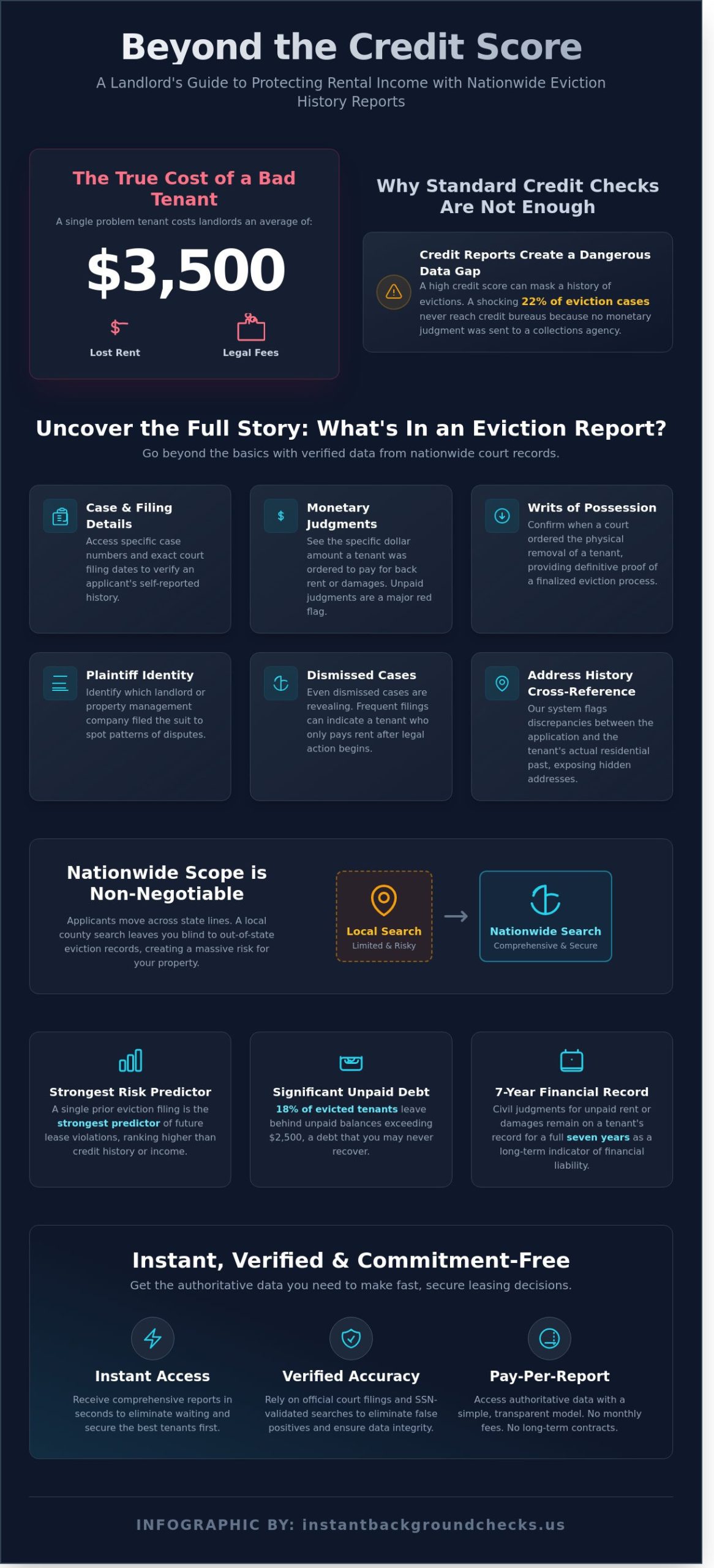
A single bad tenant costs the average property owner $3,500 in legal fees and lost rent before an eviction is even finalized. You understand that protecting your monthly cash flow is a non-negotiable part of managing property. Relying on a basic credit check often hides a tenant’s true eviction history, and searching individual county courthouses manually is a slow, outdated process. It’s frustrating to deal with hidden monthly fees and complex subscriptions just to get the facts you need to make a fast decision.
You deserve instant, verified data to protect your assets right now. This guide shows you how to access comprehensive records through our nationwide background check services to secure your rental income. We’ll explain how to get a clear yes or no on previous court filings with no long-term financial commitment. You’ll learn to pull official records from across the U.S. immediately and get results that eliminate the guesswork from your screening process. Stop waiting on paperwork and start using a secure tool to protect your portfolio.
Key Takeaways
- Identify hidden risks by accessing nationwide public records that provide critical data beyond standard credit reports.
- Access a comprehensive eviction history including case numbers and judgment amounts to verify applicants instantly.
- Safeguard your rental income from the high cost of legal fees and professional tenants who exploit screening gaps.
- Execute secure background checks across the U.S. using a streamlined name and Social Security Number search.
- Retrieve authoritative data in seconds with a pay-per-report model that eliminates monthly fees and long-term contracts.
What is an Eviction History Report and Why is it Critical?
An eviction history report is a specialized record of civil court proceedings between landlords and tenants. These reports aggregate data from nationwide public records, providing a deeper look than standard financial snapshots. Unlike a credit score, which measures debt management, an eviction search tracks legal filings and final judgments. A filing signifies that a landlord initiated legal action; a judgment confirms the court’s final ruling against the tenant. Both indicators are critical for risk assessment. Data from the Eviction Lab at Princeton University suggests that a single prior filing is the strongest predictor of future lease violations. It ranks higher than credit history or income levels in forecasting tenant risk. Austin landlords must identify these patterns immediately to protect their assets.
The Limitations of Standard Credit Checks
Standard credit reports often fail to capture the full picture of a tenant’s reliability. A high credit score can mask a history of rental litigation if the previous landlord didn’t use a collections agency. Approximately 22% of eviction cases never reach credit bureaus because no monetary judgment was reported to a debt collector. This creates a dangerous data gap. Only a specialized search of public records can bridge this void. Relying solely on credit checks leaves you exposed to applicants with a history of property damage or lease breaches that didn’t involve unpaid debt.
Nationwide vs. Local Court Records
Limiting your search to local county records is a high-risk strategy. Applicants move across state lines frequently. Our nationwide background check services ensure you don’t miss filings from previous residences in other states. We provide background checks across the U.S. by aggregating millions of records into a single, instant report. This centralized approach eliminates the need to manually contact individual courthouses. Serving clients nationwide, we offer the tools to track tenant movement and identify red flags regardless of where they occurred. Accessing these verified databases is the only way to ensure your screening process is comprehensive and legally grounded.
- Instant Access: Get results immediately to make fast leasing decisions.
- Comprehensive Data: Search millions of records from all 50 states.
- Verified Accuracy: Use official court filings to confirm applicant history.
What Information Appears in an Eviction History Search?
A professional eviction history search provides the raw data you need to make an informed leasing decision. It goes beyond a simple summary. Each report delivers specific case numbers, exact filing dates, and the final judgment amounts. Our nationwide background check services pull this information from a massive network of state and county courts to ensure no record is missed. We use Social Security number validation to anchor every result to the specific applicant. This process eliminates the risk of “false positives” associated with common names. It’s a precise, data-driven approach to risk management.
The report also cross-references the applicant’s previous address history. If a tenant lived at a property for 12 months but left it off their application, our system flags the discrepancy. You’ll see the full scope of their residential past, including:
- Writ of Possession: This confirms a court ordered the physical removal of the tenant.
- Plaintiff Identity: Know exactly which landlord or management firm filed the suit.
- Legal Outcomes: See if the case ended in a judgment, a dismissal, or a mediated settlement.
Civil Judgments and Monetary Awards
Court-ordered payments for back rent or property damage are documented as civil judgments. These records show the specific dollar amount the tenant was ordered to pay. An “Unsatisfied Judgment” is a critical red flag; it means the debt remains unpaid years after the court date. Data from 2023 indicates that 18% of evicted tenants leave behind unpaid balances exceeding $2,500. These financial records stay on a report for seven years, serving as a permanent indicator of the tenant’s past financial liability. You shouldn’t ignore these figures when calculating a prospect’s future ability to pay.
Dismissed Cases and Filings
Dismissed cases still appear in public records and provide vital context. A single dismissal might be a mistake, but frequent filings suggest a pattern of “pay and stay” behavior. This occurs when a tenant only pays rent after legal action begins. Serving clients nationwide, we provide the tools to see who initiated the action. Review the “Plaintiff” information to see if the applicant has a history of disputes with professional management companies. You can access these deep-dive records through our comprehensive search tools to verify every detail before signing a lease.
The Real Cost of Skipping an Eviction History Check
Skipping a background check is a high-stakes gamble with your property’s profitability. The average total cost of a single eviction can easily climb to $7,500. This figure accounts for lost rent, legal expenses, and property restoration. You risk encountering the “Professional Tenant.” These individuals specialize in exploiting gaps in DIY screening processes. They understand legal loopholes and use them to live rent-free for months at a time. A comprehensive eviction history report functions as a low-cost insurance policy. It protects you from massive future losses by identifying high-risk applicants before they get the keys. Get the data you need immediately to secure your investment.
Lost Rental Income and Turnover Costs
A typical eviction battle lasts 92 days from the first missed payment to the physical removal of the tenant. If your unit rents for $2,100 per month, you lose $6,300 in base income alone. The financial drain doesn’t stop there. You must fund new marketing campaigns and re-screening fees for replacement applicants. Turnover costs for a neglected unit average $1,850 for deep cleaning and minor repairs. Beyond the money, dealing with hostile, non-paying residents causes immense emotional stress. Protecting your peace of mind requires accurate data from nationwide background check services. Don’t let a single bad actor derail your cash flow.
Legal Fees and Court Costs
Legal expenses accumulate rapidly during the filing process. Standard attorney fees for an uncontested eviction start at $500; however, contested cases often exceed $2,200 in professional fees. Landlords must also pay approximately $350 for serving legal papers and court filing fees. These out-of-pocket costs are rarely recovered. Statistics show that 88 percent of monetary judgments against evicted tenants remain unpaid because the individuals have no garnishable assets. You won’t get that money back. Using background checks across the U.S. allows you to see these red flags in public records immediately. Search our eviction history database now and avoid the courtroom later.
How to Perform a Nationwide Eviction History Search
Securing your investment requires a rigorous screening process. Landlords must move quickly to secure high-quality tenants before competitors do. Follow these five steps to execute a professional eviction history search using nationwide background check services.
- Step 1: Collect the applicant’s full legal name and 9-digit Social Security Number. Verified data prevents errors caused by common names or typos.
- Step 2: Access a secure portal that provides comprehensive background checks across the U.S. This ensures you see records from every state, not just local filings.
- Step 3: Enter the applicant data and trigger the instant search mechanism. Speed is vital; reliable systems deliver results in under 60 seconds.
- Step 4: Review the generated report for any civil court matches. Focus on case numbers and filing dates to ensure the record belongs to your applicant.
- Step 5: Compare findings against your written tenant-selection criteria. Consistency protects you from discrimination claims and ensures objective decision-making.
Verifying Applicant Identity
SSN validation is the most effective way to stop applicants from using aliases or stolen identities. A Social Security Number links the individual to their financial and legal past across all 50 states. Previous address history reveals where the applicant lived during the last 7 to 10 years. This footprint tells you exactly which jurisdictions require deeper scrutiny. Identity verification is the foundation of any reliable background search. Using verified data ensures the eviction history you review is accurate and belongs to the person standing in front of you.
Interpreting Court Dispositions
Court records use specific legal language that landlords must understand. A “judgment for plaintiff” indicates the court ruled in favor of the previous landlord. This usually means the tenant was forced to vacate and may owe money. Conversely, a “dismissed” case might stem from a settled debt or a procedural error. Records from 2017 or earlier may still appear, but most landlords focus on the last 5 years of rental history. Distinguish between a “failure to pay rent” and a “breach of lease.” A breach of lease often involves property damage or unauthorized occupants, which suggests higher risk than a simple late payment. Protect your property by getting the facts today. Run a nationwide eviction search now to see the full picture.
Instant Nationwide Eviction Checks with No Monthly Fees
Austin landlords need fast answers to protect their rental property investments. We provide instant background checks that deliver facts without the burden of monthly overhead. You pay only for the reports you need. Results arrive in seconds, not days. Our USA-based operation serves clients nationwide, maintaining a high standard of accuracy across every state. We prioritize security. Our systems use 256-bit encryption to safeguard both landlord and tenant information, ensuring privacy is never compromised during the screening process.
The Advantage of Pay-Per-Report Pricing
Many screening companies force you into expensive subscriptions. These services charge you every month even when your units are full. That model doesn’t work for independent landlords or small business owners managing a handful of properties. We offer a better way. Our transparent pricing means you never face hidden annual fees or surprise surcharges. You get professional-grade reports on demand, keeping your screening costs predictable and manageable. This flexibility allows you to scale your screening volume up or down based on your current vacancy rate without financial penalty.
Authoritative Data and Speed
Experience matters when handling legal records. As a division of Tenant Screening Services, LLC, we’ve delivered authoritative data since 1982. This long history ensures you receive a comprehensive eviction history that you can trust. Speed is your biggest advantage in a fast-moving rental market. You need to identify high-quality applicants immediately. Accessing data in seconds prevents you from losing a great tenant to a competitor while waiting days for a manual search to complete.
Using our nationwide background check services provides several key benefits:
- Immediate Access: Public records are retrieved the moment you submit your request.
- Verified Accuracy: We pull data from authoritative government and public databases.
- Nationwide Coverage: We track eviction history across the U.S. to catch records from previous states.
- No Commitments: No contracts or long-term obligations are required to access our tools.
Verify your applicant’s records right now to make an informed decision with confidence. Don’t let a 48-hour delay cost you a reliable renter. Get your instant eviction history report now.
Secure Your Property With Nationwide Data
Protecting your rental investment requires more than a simple credit check. It demands verified data from a nationwide network. Skipping a thorough search of an applicant’s eviction history exposes you to avoidable risks like thousands in lost rent and costly legal proceedings. Our system provides a direct gateway to official public records across the entire United States. You get the facts you need to make an informed decision without any delay.
Since 1982, we’ve served clients nationwide with a focus on speed and reliability. You won’t find any monthly or annual fees on our platform. You pay only for the specific records you request. Our system delivers instant results sourced from verified government databases. This ensures you have the most current information available at your fingertips. Don’t leave your property’s future to chance when professional-grade tools are ready for your use.
Take charge of your screening process and gain total peace of mind right now.
Frequently Asked Questions
How far back does an eviction history report go?
Most eviction history reports cover a 7 year period. This limit is established by the Fair Credit Reporting Act (FCRA) for most civil judgments and public records. Our nationwide background check services provide data spanning 84 months across all 50 states. You’ll see specific filing dates, case numbers, and final outcomes for this entire duration to ensure a complete risk assessment.
Do evictions show up on a standard credit report?
Standard credit reports from the three major bureaus don’t include eviction records directly. These bureaus stopped reporting most civil judgments in 2017 to improve data accuracy. However, if a landlord sent unpaid rent to a collection agency, that specific debt will appear on the credit file. You must run a specialized eviction search to see actual court filings and tenant history.
Can a tenant have an eviction removed from their history?
Tenants can only remove an eviction if they successfully petition the court for an expungement or sealing of the record. This process usually requires proving the case was filed in error or that the tenant won the legal judgment. Approximately 15 percent of cases are settled or sealed before they reach public databases. If the record is active and accurate, it remains visible for 7 years.
What is the difference between an eviction filing and an eviction judgment?
An eviction filing is the initial legal notice a landlord submits to the court to start the removal process. An eviction judgment is the final court order confirming the landlord won the case and the tenant must vacate the premises. Our reports track both stages. Filings indicate potential risk and behavioral patterns, while judgments confirm a legal breach of the rental contract.
Is it legal to deny a tenant based on their eviction history?
It’s legal to deny an applicant based on their eviction history as long as you apply the same criteria to every applicant consistently. You must comply with the Fair Housing Act and provide a formal adverse action notice if the report influences your decision. Many landlords set a strict 5 year threshold for clean records to minimize financial risk and property damage.
How long does it take to get an eviction history report back?
You get results instantly when using our automated search tools. Our system accesses millions of public records across the U.S. in seconds. There’s no waiting for manual courthouse lookups in 99 percent of jurisdictions. You can verify a tenant’s background and make a confident leasing decision within 2 minutes of submitting the search request through our secure portal.
Do I need the tenant’s permission to run an eviction search?
You need written consent from the tenant before running any background check for housing purposes. The Fair Credit Reporting Act requires landlords to obtain a signed disclosure and authorization form. This protects your business legally and ensures the screening process is transparent. Keep these signed authorizations on file for at least 3 years to maintain compliance with federal regulations.
What if the tenant was evicted in another state?
Our nationwide background check services identify evictions regardless of which state the filing occurred in. We aggregate data from over 3,000 counties across the U.S. to ensure no records are missed. A tenant moving from Florida to Texas won’t be able to hide a prior judgment. You get a complete, verified picture of their rental history across all 50 states instantly.
