

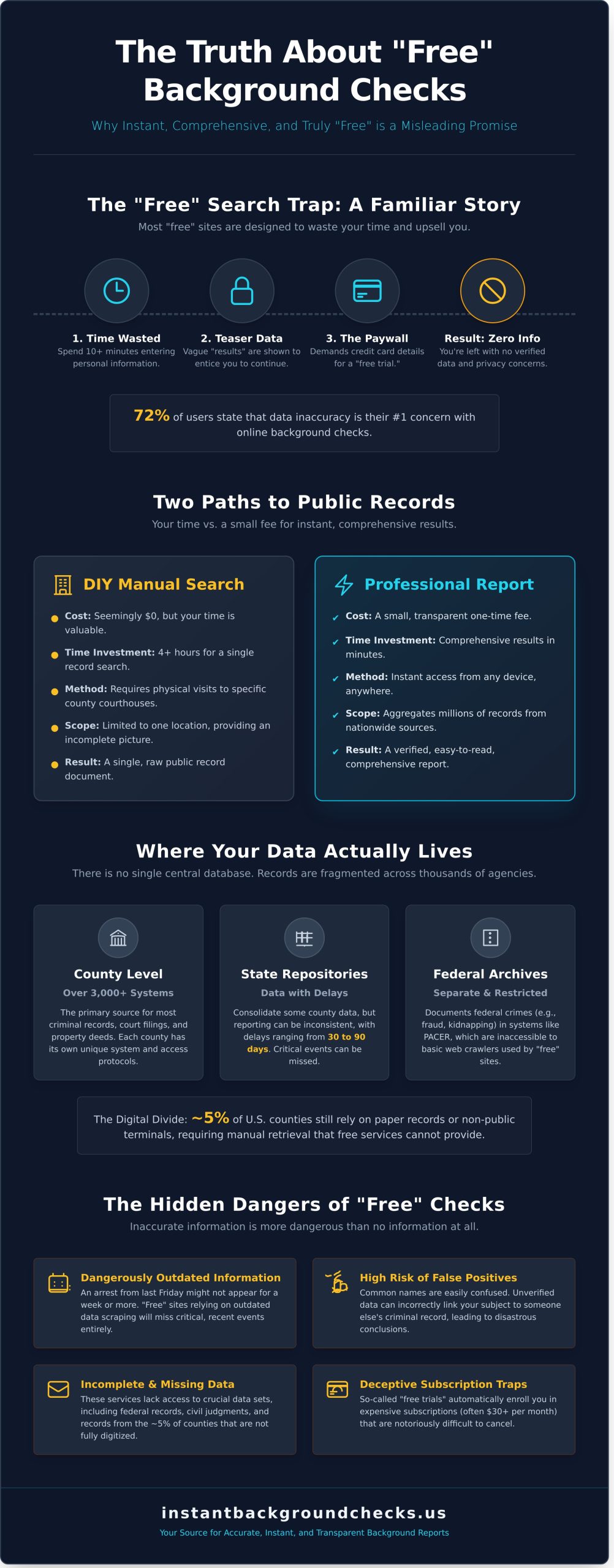
Most “free” background check websites are designed to fail. You’ve likely experienced it yourself. You spend ten minutes entering information, only to hit a paywall demanding credit card details for a “trial subscription.” It’s a frustrating waste of time that leaves you with zero verified information and serious doubts about the data’s accuracy, a risk that 72% of users say is their top concern.
This guide cuts through that noise. We’ll show you the legitimate, no-cost methods to access public records directly from official sources. You will also learn precisely when a professional, nationwide background check is the only way to get the accurate, FCRA-compliant data required for critical decisions. Discover the difference between raw public data and a comprehensive report, and get the verified results you need instantly.
Key Takeaways
- Understand the architecture of U.S. public records to identify exactly where to begin your manual search for information.
- Access a step-by-step guide for using official, no-cost government databases to find specific public records yourself.
- Uncover the critical risks of relying on a free background check, from false positives due to common names to dangerously outdated records.
- Determine when a professional nationwide background check is essential for achieving complete accuracy and legal compliance.
- Learn the crucial difference between accessing a single public record and compiling a comprehensive background report.
What is a Free Background Check and Does It Truly Exist?
The term free background check promises instant, comprehensive information at no cost. This promise is misleading. In reality, a truly free, instant, and accurate background check does not exist in the commercial market. The process of acquiring, verifying, and compiling sensitive data from thousands of jurisdictions nationwide requires significant technological and financial resources. Companies that claim to offer this service for free are often using deceptive marketing to hide costs.
A critical distinction must be made between accessing a single public record and obtaining a full background report. A public record is a standalone piece of information, like a court filing or a property deed, available from a specific government agency. Understanding what is a background check reveals it’s a comprehensive dossier. It aggregates millions of data points from disparate sources-criminal records, civil judgments, marriage licenses, and more-into a single, verified report. This aggregation is the service you pay for.
Most websites advertising “free” results provide teaser data. They will confirm a person’s name and possible location, then erect a paywall to reveal the critical details you actually need, such as criminal history. This model preys on urgency. Furthermore, the legal landscape is shifting. As of 2024, over 15 states have enacted comprehensive consumer data privacy laws. This trend is accelerating, making the large-scale aggregation required for automated searches more complex and legally restricted. By 2026, expect truly free automated searches to be virtually non-existent.
DIY Public Records vs. Instant Professional Reports
The only way to access some records for $0 is the manual Do-It-Yourself method. This involves physically visiting a county courthouse, navigating their system, and printing documents. This process can consume over four hours for a single record search. An automated service aggregates millions of these records for a small fee, delivering a comprehensive report in minutes. The trade-off is clear: Is your time worth more than a $20 report?
The “Free Trial” Subscription Trap Exposed
Many “unlimited search” providers use a deceptive free trial to capture your credit card information. After the trial, which can be as short as 24 hours, you are automatically enrolled in a recurring subscription, often costing more than $30 per month. Canceling these services is notoriously difficult, designed to trap users into multiple billing cycles. Instant Background Checks operates on transactional transparency. You pay for a single, comprehensive report. There are no subscriptions, no hidden fees, and no recurring bills. Your transaction is secure, private, and complete.
The Architecture of Public Records: Where Your Data Lives
There is no central database for all public records in the United States. This is a critical fact that most free search sites intentionally omit. Your data isn’t in one place; it’s scattered across a fragmented network of thousands of independent government agencies. Understanding this architecture reveals why a legitimate background check requires more than a simple web search.
Information is siloed at three primary levels:
- County Clerks: The majority of criminal records, property deeds, and court filings originate here. With over 3,000 counties in the U.S., each operates its own system with unique access protocols.
- State Repositories: These agencies, like a state’s Department of Public Safety, consolidate some county-level data. However, reporting can be inconsistent, with delays ranging from 30 to 90 days.
- Federal Archives: Federal crimes, such as fraud or kidnapping, are documented in a separate system. Federal civil and criminal cases are indexed in Nationwide Public Databases like the Public Access to Court Electronic Records (PACER) system, which is inaccessible to basic web crawlers.
The time it takes for a record to become digitally available is another major variable. An arrest made on a Friday in a major city might be logged by Monday. In a rural jurisdiction, that same record could take over a week to be processed and entered into a searchable database. A so-called ‘free background check’ that relies on scraping outdated information will miss these critical updates entirely.
Digital vs. Paper Records in the Modern Era
A public record repository is a government-maintained archive of legal actions. While most urban counties have digitized these archives, an estimated 5% of U.S. counties still rely on paper records or non-public terminals. Accessing a file in these locations requires a physical court runner. Professional services bridge this gap by combining instant digital aggregation with manual retrieval, ensuring complete national coverage. This is a resource-intensive process that free services cannot replicate.
The Role of the Social Security Administration and SSN Trace
A name is not enough for an accurate search. The first and most vital step in any professional background check is a Social Security Number (SSN) Trace. This isn’t a government search; it’s a powerful query of private-sector credit and utility records legally associated with a specific SSN. This trace reveals a history of known addresses, which acts as a roadmap. It tells investigators exactly which county and state jurisdictions to search for records.
Without a verified SSN, a search for “John Smith” in Austin could yield dozens of irrelevant results and miss the correct one entirely if he recently moved from Dallas. Verified SSN validation is the anchor for accuracy. It ensures you are investigating the right person, every time. Compiling this data requires access to multiple, disconnected systems. A truly comprehensive background check automates this complex process for you, delivering a verified and actionable report instantly.
How to Conduct a Manual Search Using Nationwide Public Databases
Conducting a background check on your own is possible, but it demands significant time and a clear understanding of public records systems. While the idea of a completely free background check is appealing, the reality is a patchwork of disconnected, and often paywalled, government databases. You are left to assemble a puzzle with most of the critical pieces missing.
Accessing State and Federal Repository Links
Each state maintains its own criminal record repository. To find it, use a direct search query like “official [State Name] criminal history search.” Be prepared for fees. For example, the Texas Department of Public Safety charges over $10 for a name-based search as of 2023. A no-cost alternative is the state’s Department of Corrections (DOC) inmate lookup, which shows current or past incarcerations but omits arrests, misdemeanors, and acquittals.
The critical flaw in this approach is its limited scope. A state-level search only reveals offenses within that state’s jurisdiction. In a society where over 8.9 million Americans move between states each year, according to 2022 U.S. Census Bureau data, a single-state search provides a dangerously incomplete picture. A clean record in Florida means nothing if the individual has a criminal history in Georgia.
Federal records present another layer of complexity. The official portal is PACER (Public Access to Court Electronic Records), which covers federal bankruptcy, civil, and criminal cases. PACER is not free. It costs $0.10 per page viewed, with costs capped at $3.00 per document. Accessing these records requires careful navigation and an understanding of legal compliance. Misinterpreting this data or using it improperly for decisions like hiring can have serious consequences, as detailed in the FTC guidelines on background checks.
Searching the National Sex Offender Public Website
The U.S. Department of Justice’s National Sex Offender Public Website (NSOPW) is the only truly free, nationwide government database available for public safety checks. It aggregates registered sex offender data from all 50 states, U.S. territories, and participating tribal nations. A search by name and geographic area can instantly identify registered offenders living, working, or attending school nearby. This is a critical first step for personal safety.
However, interpreting NSOPW results requires caution. A common name can generate multiple matches. Verifying an individual’s identity using a known address or date of birth is essential to avoid false accusations. Most importantly, this registry is not a complete criminal history. It contains only sex offense convictions that mandate registration. It will not reveal other violent crimes, financial fraud, or DUIs. A clear result from the NSOPW does not equal a clean criminal record.
Ultimately, a manual free background check is a series of compromises. You trade comprehensive accuracy for a low cost, but that cost is rarely zero. You are left with isolated data points, not a complete, verified report. An effective background check requires instant, cross-referenced data from thousands of sources nationwide. Anything less is just a guess.
The Hidden Risks of Relying on Free Background Checks
The promise of a “free” report is tempting. It feels fast, easy, and without cost. But the real price is paid in accuracy, legality, and your personal privacy. These platforms operate on a flawed model that exposes users to significant liability. They are not a substitute for a professional, comprehensive background screening service.
The most immediate danger is the “false positive.” A search for a common name like ‘James Williams’ can return dozens of criminal records attached to different individuals across the country. Free sites lack the verification protocols, such as cross-referencing with a date of birth or address history, to distinguish between them. You are left with raw, unverified data that is often incorrect. At the same time, your search activity isn’t private. These “free” providers often fund their operations by collecting and selling your search data to third-party marketing firms and data brokers. Your confidential query becomes a commodity.
Outdated Information and Accuracy Gaps
Free search sites rarely pull information in real-time. To cut costs, they scrape and cache data from public sources, often updating their databases only once or twice a year. This massive data latency means you could easily miss a serious conviction that occurred just three months ago. Conversely, a record that was legally expunged in 2023 might still appear as an active conviction, creating a false alarm. Data accuracy in background screening is a legal requirement under the FCRA.
FCRA Compliance for Landlords and Employers
Using a background check for professional decisions requires a “permissible purpose” under the Fair Credit Reporting Act (FCRA). A quick Google search or a report from a non-compliant free background check website is not a legal substitute for a consumer report. Making a decision based on this unverified data can result in severe financial penalties.
An “adverse action” is any negative decision made based on information in a background report. This includes:
- Denying a rental application
- Refusing to hire a candidate
- Terminating an employee
- Denying a promotion
Taking any of these actions based on data from a non-compliant source is a violation of federal law. The Consumer Financial Protection Bureau (CFPB) enforces penalties that can exceed $1,000 per violation. Willful non-compliance can lead to class-action lawsuits and significant punitive damages. The risk isn’t worth the illusion of saving a few dollars.
Don’t gamble with unverified data. Protect yourself and your business with a compliant, accurate report. Get instant access to verified public records now.
The Professional Alternative: Serving Clients Nationwide with Instant Results
The allure of a free background check is strong, but the risks associated with incomplete or outdated information are significant. When your safety, assets, or business reputation are on the line, you can’t afford to guess. True peace of mind demands a professional-grade solution built on accuracy, speed, and comprehensive data. Forget unreliable databases and hidden subscription traps. The alternative is a direct, transparent service designed for immediate, actionable intelligence.
We provide verified, multi-state reports that deliver the complete picture. Our system is engineered to bypass the limitations of localized searches and give you the authoritative information you need in minutes, not days. This is the professional standard for modern screening.
Why Nationwide Coverage Matters for Modern Screening
A search limited to a single state is a critical vulnerability. In 2022 alone, the U.S. Census Bureau reported that 31.4 million Americans moved. An individual’s history doesn’t stop at the state line. Our nationwide background check services access over 650 million criminal records from all 50 states, consolidating a multi-state history into a single, unified report. This ensures that a past record from another jurisdiction is never missed.
Our commitment is to deliver comprehensive data without complication. That begins with a transparent, pay-per-report model. You don’t need a monthly subscription. You don’t need an annual contract. You pay only for the specific report you need, exactly when you need it. There are no hidden fees or surprise charges. This straightforward approach puts you in complete control of the screening process and your budget.
Unlike a basic free background check that often pulls from a single, unverified source, our reports are compiled from thousands of official public record databases. This includes information from county courthouses, state-level departments of correction, and federal agencies. More importantly, our USA-based team provides a critical layer of verification. Our analysts work to ensure the data is accurately matched to your subject, drastically reducing the false positives that plague purely automated systems.
Your security and privacy are paramount. All searches are 100% confidential and protected with 256-bit encryption. We never sell your personal information. The process is discreet, secure, and built for your confidence.
Instant Results with No Monthly or Annual Fees
Get the data you need, now. Our system provides a complete report directly to you in minutes. Pay only for what you use with zero recurring fees. Your comprehensive search includes:
- Nationwide Criminal Records: Access felony and misdemeanor records from across the U.S.
- Eviction History: Uncover prior landlord-tenant disputes and court filings.
- Credit Reports: Gain financial insights for tenant and employment screening.
- Sex Offender Registry Search: Search the national database for registered offenders.
Your confidential report is just a few clicks away. Get your instant, nationwide background check now.
Get Verified, Instant Results Now
The search for a truly comprehensive free background check often ends with a hard truth: you get what you pay for. These services typically pull from limited, outdated databases, leaving critical gaps in a person’s history. Manual searches through disconnected public record systems are not only time-consuming but also prone to error, exposing you to significant unknown risks. You can’t afford to base important safety and financial decisions on such fragmented information.
You need a professional, consolidated report from a trusted source. Instant Background Checks provides immediate access to a verified, nationwide network of official public records. Since 1982, our USA-based operation has delivered confidential, FCRA compliant screening for landlords and employers serving clients nationwide. We don’t lock you into contracts. You pay only for the search you need, with no monthly or annual subscription fees-ever. It’s direct, secure, and powerful.
Don’t settle for uncertainty. Run an Instant Nationwide Background Check Now to get the complete, accurate information you require in minutes. The power to verify is in your hands.
Frequently Asked Questions
Is there a 100% free background check that is actually accurate?
No, a 100% free background check that is both comprehensive and accurate doesn’t exist. These sites often use outdated or incomplete public data. Professional services pay for direct, secure access to premium databases, including county, state, and national records. This ensures the information is current and verified. A free search will miss critical records that a paid, professional service uncovers, leaving you with an incomplete and unreliable report.
How can I do a background check on myself for free?
You can perform a limited background check on yourself by manually searching public records. This requires individually contacting county clerk offices, state repositories, and other government agencies to request your files. You can also review your credit reports for free once per year from Equifax, Experian, and TransUnion. This manual process is time-consuming and won’t provide the consolidated, instant report that a professional nationwide service delivers.
What shows up on a professional background check that I can’t find on Google?
A professional background check accesses information not available through a standard Google search. This includes non-indexed court records, criminal history from national databases, and records from jurisdictions that don’t publish data online. It also verifies identities against official government sources and can include details on liens, bankruptcies, and professional licenses. Google only indexes about 4% of the web; professional checks search the other 96% for a complete picture.
Are free background check sites safe to use with my personal data?
No, free background check sites often pose a significant security risk. Many of these platforms lack the robust security protocols required to protect your personal information, making it vulnerable to breaches. A 2023 cybersecurity report showed that over 60% of small data brokers experienced at least one data breach. These sites may also sell your search data to third-party marketers. Always use a confidential service with encrypted connections and a clear privacy policy.
How long does a nationwide background check take to complete?
A comprehensive nationwide background check delivers instant results for most digital records. Searches requiring manual retrieval from specific county courthouses can take 1 to 3 business days to complete. The exact turnaround time depends on the search depth and the jurisdiction’s processing speed. Professional services use a network of court runners and direct database integrations to provide the fastest, most accurate results possible across the U.S.
Why do some government background checks cost money while others are free?
Government agencies charge fees to cover the administrative costs of accessing, retrieving, and certifying official records. A “free” search is typically a limited portal query. A paid request, like a certified court document or an official DMV record, requires staff time and resources to process and verify. These fees ensure the record’s authenticity and fund the operational budget of the public records office that maintains them.
Can I use a free background check to screen a potential tenant?
No, you cannot legally use a free background check for tenant screening. This process is regulated by the Fair Credit Reporting Act (FCRA). Using a non-FCRA compliant service for housing, employment, or credit decisions can lead to severe legal penalties, including fines up to $1,000 per violation. You must use a professional, FCRA-compliant screening service that follows strict procedures for data accuracy, consumer consent, and dispute resolution.
What is the difference between a criminal search and a full background check?
A criminal search focuses exclusively on criminal records, such as felonies and misdemeanors. A full background check is far more comprehensive. It includes a criminal search but also verifies identity, address history, and financial records like bankruptcies or liens. A complete check can also include civil court records, driving history, and professional license verification. A criminal search answers one specific question; a full background check provides a complete profile.
