
![Professional woman in a blazer stands beside a desk with a laptop displaying charts, in a high-rise office with a city skyline.] ,](https://instantbackgroundchecks.us/wp-content/uploads/How-to-Verify-Tenant-Income-in-Austin-A-Landlords-2026-Guide-Hero-Image-1080x675.jpg)
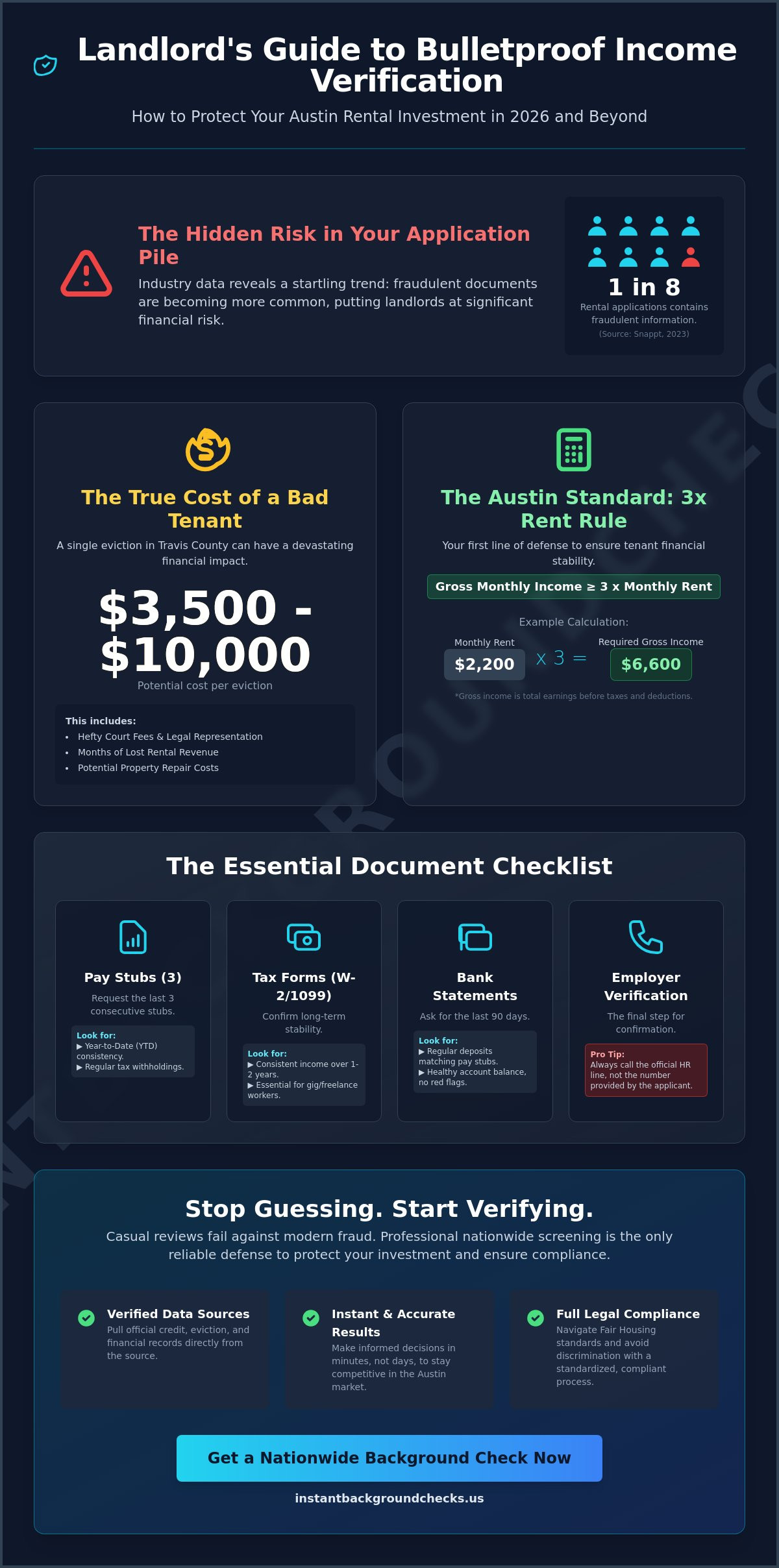
In 2023, industry data from Snappt revealed that 1 in 8 rental applications contains fraudulent financial documentation. For an Austin landlord in 2026, a doctored PDF isn’t just a minor annoyance; it’s a gateway to expensive eviction proceedings and lost revenue. You must know exactly how to verify tenant income Austin without falling into the trap of sophisticated pay stub generators or complex gig-economy earnings. Professional nationwide background check services provide the only reliable defense against these risks by pulling data from official, verified sources.
You understand that a reliable tenant is the foundation of a profitable rental property. However, the fear of misinterpreting Austin fair housing rules or missing hidden debts can make the screening process feel like a legal minefield. We’ll give you the exact steps to confirm an applicant’s earnings while maintaining total compliance with local and federal laws. This guide empowers you to stop guessing and start using authoritative data to protect your investment. Using background checks across the U.S. ensures that no matter where your applicant moved from, their financial history is transparent and accurate.
This article breaks down the legal requirements for 2026 and provides a clear roadmap for verifying self-employed applicants. You’ll learn how to access comprehensive financial records quickly so you can sign your next lease with absolute confidence.
Key Takeaways
- Apply the 3x rent rule effectively to ensure applicants possess sufficient monthly earnings for long-term lease stability.
- Master how to verify tenant income Austin landlords require by scrutinizing pay stubs and tax documentation for year-to-date accuracy.
- Validate non-traditional income from the gig economy and freelance sectors using verified tax returns and official financial records.
- Navigate legal compliance and Fair Housing standards to avoid discrimination while evaluating student or medical debt during screening.
- Accelerate your verification process with nationwide background check services that provide instant access to comprehensive credit and eviction data.
Why Income Verification is Critical for Austin Rental Success
Income verification confirms an applicant has the stable funds required to cover monthly rent. In the Austin market, the standard requirement is the 3x rent rule. This means a tenant must earn three times the monthly rent in gross income. For a property renting at $2,200, the applicant needs $6,600 in monthly earnings. This metric is a central part of a comprehensive tenant screening process used by professional landlords. Understanding how to verify tenant income Austin requires looking at gross income, which is the total earned before taxes, versus net income, the actual cash available for bills. Search now to ensure your applicants meet these standards.
Eviction costs in Travis County are high. A single eviction can cost a landlord between $3,500 and $10,000 when accounting for court fees, legal representation, and months of lost revenue. Verifying income on the front end is a financial necessity to protect your investment. Landlords serving clients nationwide recognize that automated verification is the only way to stay profitable. Learning how to verify tenant income Austin effectively prevents long-term losses and keeps your cash flow consistent.
The Risks of Skipping Professional Verification
Skipping formal checks increases the probability of late payments or total rent default. Professional “tenant scammers” now use high-quality fraudulent documents to bypass casual reviews. They fabricate pay stubs and W-2s that look authentic. A thorough search identifies these discrepancies immediately. You must also use credit reports to find undisclosed debt. High monthly debt payments eat into “available” income, making even a high-earning applicant a risk. Our nationwide background check services help identify these red flags before you sign a lease. Don’t rely on gut feelings when digital records provide the facts.
Austin Market Trends in 2026
The 2026 Austin market remains competitive, with rent-to-income ratios tightening as housing costs fluctuate. Landlords must act fast. High competition means you have less time to vet applicants, but rushing leads to errors. Verification must be instant and accurate. We provide background checks across the U.S. to ensure you have the data you need in minutes. It’s the only way to maintain a professional edge. The income-to-rent ratio is a formula used by Austin landlords to determine if an applicant’s gross monthly income meets the minimum threshold of 300 percent of the monthly rent price.
Essential Documents for Verifying Tenant Earnings
To master how to verify tenant income Austin, you must collect a standardized set of documents that prove financial stability. Reliable landlords don’t accept verbal claims. They demand a paper trail. Start by requesting the last three consecutive pay stubs. These documents reveal the year-to-date (YTD) totals, which help you determine if the applicant’s current earnings match their annual projections. Check the tax withholding for consistency; irregular deductions often signal under-the-table payments or temporary work status.
While pay stubs show current flow, W-2 and 1099 forms from the previous tax year confirm long-term stability. These are essential for self-employed applicants who may have fluctuating monthly deposits. For a complete picture, request bank statements from the last 90 days. You are looking for regular deposits that match the claimed employer names. While most private landlords set their own criteria, following the City of Austin income verification guidelines ensures your process aligns with local standards for affordability and compliance.
- Pay stubs: Analyze the YTD gross pay to ensure the applicant has maintained steady work for at least six months.
- W-2 and 1099 forms: Use these to verify that the applicant’s income has remained consistent over the last 12 to 24 months.
- Bank statements: Confirm that the net pay shown on stubs actually reaches their account.
- Employer verification letters: These are vital for new hires. Always call the company’s official HR line found through a neutral search, rather than the number provided by the applicant.
How to Spot Fraudulent Pay Stubs
Fraudulent documents are increasingly common; a 2024 industry survey found that 15% of rental applications contain misrepresented financial data. Check for perfectly round numbers. Legitimate payroll calculations rarely result in an exact $5,000.00 gross pay. Verify the math manually. If the deductions and net pay don’t add up to the gross total, the document is a forgery. Cross-reference the employer name with the Texas Secretary of State or nationwide business registries to ensure the company exists. You can verify applicant history quickly to ensure you aren’t dealing with a professional scammer.
Using SSN Validation to Confirm Identity
Identity verification must happen before you analyze earnings. If the applicant uses a “borrowed” identity, the income data is useless. Performing social security number validation confirms the applicant is who they claim to be. This step is the foundation of a nationwide background check. A verified SSN ensures that the credit report you pull belongs to the person standing in front of you. Without this link, you risk renting to someone with a history of evictions hidden under a different name. Mastering how to verify tenant income Austin requires this level of digital due diligence to protect your investment.
Handling Self-Employed and Non-Traditional Income Sources
Austin’s 2026 rental market is defined by the gig economy. Traditional pay stubs are becoming less common as freelance tech roles and short-term rental management grow. If you want to know how to verify tenant income Austin landlords must look beyond the W-2. The IRS Form 1040 remains the gold standard for self-employed applicants. Demand the two most recent years of tax filings to establish a baseline of earnings. This document provides a verified, legal record of net income after expenses.
For active small business owners, tax returns only show the past. Request a Year-to-Date Profit and Loss (P&L) statement to see current performance. This document reveals if a business is thriving or struggling in the current quarter. Retirees or high-net-worth individuals require a different strategy. Use brokerage statements or a formal “Proof of Funds” letter from a financial institution. Ensure these documents are dated within the last 30 days to confirm liquidity. Our nationwide background check services help you verify these details quickly across all 50 states.
- IRS Form 1040: Use Schedule C to identify true net profit.
- P&L Statements: Look for consistent revenue trends over the last 12 months.
- Brokerage Accounts: Verify that assets are liquid and not locked in long-term restricted vehicles.
- Bank Statements: Cross-reference deposits with stated income to spot discrepancies.
Verifying the Austin Tech Freelancer
Tech contractors often earn high but irregular pay through 1099 income. Don’t rely on a single month of bank statements. Request 1099 forms from major clients or platform-specific earnings reports. Analyze a 6-month period of deposits to distinguish between stable revenue and sporadic windfalls. A freelancer with $20,000 in January but $0 in February and March presents a higher risk than one with a steady $7,000 monthly average. Consistency is more important than a one-time high balance.
The Role of the Credit Report in Financial Vetting
Income figures are meaningless without context. A high earner with massive monthly debt is often closer to eviction than a moderate earner with no liabilities. A comprehensive tenant credit check is the only way to reveal an applicant’s true disposable income. It exposes hidden debt obligations like high-interest credit cards, student loans, or auto leases. Look for collections or accounts that are 30, 60, or 90 days past due. These are immediate signals of financial instability. When you understand how to verify tenant income Austin applicants provide, you must balance their earnings against their existing debt load to ensure they can actually afford the rent.
Legal Compliance and Fair Housing Standards in Austin
Austin landlords face strict scrutiny regarding tenant screening. The federal Fair Housing Act prohibits discrimination based on protected classes. In Austin, local ordinances extend these protections to include source of income. You must apply the same verification standards to every applicant without exception. Any deviation creates legal vulnerability. Document your process thoroughly to prove consistency. Austin’s 2026 regulatory environment requires specific handling of financial history. Local guidelines now discourage penalizing applicants for medical debt or student loan defaults during the screening process. Focus strictly on the ability to pay future rent. Consistency is your best defense against discrimination claims. Use nationwide background check services to ensure your data is accurate and legally obtained.
Source of Income Protections
- Housing Choice Vouchers: You cannot refuse an applicant because they use Section 8. This is a violation of Austin City Code Chapter 5-4.
- Income Calculation: When an applicant has a voucher, only calculate their portion of the rent. If the total rent is $2,000 and the voucher covers $1,500, evaluate their income against the remaining $500.
- Government Subsidies: Treat Social Security, disability payments, and child support as verified income. These are stable, recurring funds.
- Disparate Impact: Avoid setting minimum income thresholds that effectively bar all voucher holders. This practice is often viewed as a proxy for discrimination.
Adverse Action Notices
If you deny an applicant based on data found while learning how to verify tenant income Austin, you must follow federal law. The Fair Credit Reporting Act (FCRA) requires an Adverse Action Notice. This document explains that the denial was based on a background or credit report. You must provide the name, address, and phone number of the screening agency. You also must inform the applicant of their right to dispute the information. Failure to provide this notice can result in statutory damages ranging from $100 to $1,000 per violation. Professional background check providers simplify this process by generating compliant notices automatically. This maintains a clear audit trail for your records. Using background checks across the U.S. ensures you see the full picture while staying within legal bounds.
Protect your rental business with accurate, real-time data. Search public records and verify applicants instantly.
Use Professional Screening to Confirm Financial Stability
Austin’s rental market in 2026 demands rapid decision-making. Manual phone calls to employers are a relic of the past. They’re slow. They’re often unreliable. In a competitive environment, you can’t wait 48 hours for an HR representative to return a call. Professional screening delivers data immediately. InstantBackgroundChecks.us provides access to credit, criminal, and eviction records in seconds. This speed is critical for landlords learning how to verify tenant income Austin effectively. You need to know if the applicant’s reported salary matches their actual financial behavior.
Our platform operates on a pay-per-report model. You don’t pay monthly fees or subscription costs. You only pay for the data you use. This efficiency allows you to combine income verification with a detailed eviction history. This creates a 360-degree view of the applicant’s reliability. A high income means nothing if the tenant has a history of non-payment or legal disputes. We provide the tools to verify that an applicant’s financial stability is backed by a clean record.
- Get instant access to public records.
- Eliminate the guesswork of manual verification.
- Identify high-risk applicants before they sign a lease.
- Maintain professional distance with automated reporting.
Nationwide Coverage for a Transient Population
Austin added nearly 50,000 new residents between 2022 and 2023. Many of these applicants arrive from California, New York, or Florida. Local-only searches are insufficient. You need screening that follows a tenant across state lines. Our nationwide background check services catch records that regional searches miss. We provide background checks across the U.S. to ensure your applicant didn’t leave a trail of debt or unpaid rent in another jurisdiction. We serve clients nationwide to provide peace of mind in a mobile society. This broad scope prevents “rent jumpers” from hiding past issues.
Start Your Search Now
The process is streamlined for high-volume and individual landlords alike. Enter the applicant’s details. Choose your specific report. Get results instantly. Our system maintains a secure, private, and legally grounded screening archive for your records. This ensures you remain compliant with fair housing standards while protecting your investment. Digital records provide a clear audit trail. This is your first line of defense against fraud. Protect your property with fast, accurate tenant screening.
Secure Your Austin Rental Revenue Today
Effective income verification is the primary defense against future payment defaults and costly evictions. You must collect 2 or 3 months of pay stubs and cross-reference them with tax returns to confirm a stable 3 to 1 income-to-rent ratio. Staying compliant with 2026 Fair Housing standards ensures your business remains protected from legal liability. Mastering how to verify tenant income Austin landlords require is essential for maintaining a high-performing portfolio.
Don’t waste hours chasing down paperwork or guessing at financial stability. We provide nationwide background check services with USA-based support that has operated since 1982. You’ll get instant results from comprehensive nationwide databases without any monthly or annual fees. You only pay for what you need. Access the data required to make confident leasing decisions immediately.
Get an Instant Tenant Screening Report Now
Take control of your screening process and place reliable tenants with total confidence.
Frequently Asked Questions
Can I deny a tenant in Austin if they don’t have a traditional job?
Yes, you can deny an applicant who fails to meet your income requirements, but you must comply with Austin’s Source of Income Protection Ordinance. You cannot legally reject a tenant solely because their income comes from housing vouchers or social security. Focus on the total monthly earnings rather than the source. Verify all non-traditional income through official award letters or 1099 forms to ensure they meet your financial criteria.
What is the standard income-to-rent ratio for Austin apartments in 2026?
The standard income-to-rent ratio for Austin properties in 2026 is 3 times the monthly rent. This industry benchmark ensures tenants have sufficient funds for both housing and living expenses. For a median Austin apartment renting at $1,650, an applicant needs a gross monthly income of $4,950. Use our nationwide background check services to confirm these earnings are accurate and verified against official public records.
How do I verify income for a tenant who is moving from out of state?
Request a formal offer letter or the last 3 months of pay stubs from the applicant’s current or future employer. Contact the out-of-state HR department directly to confirm the salary and start date. Our platform provides background checks across the U.S., allowing you to pull records from any state instantly. This ensures the applicant’s employment history is legitimate before they relocate to the Austin area.
Is it legal to ask for bank statements in the tenant screening process?
Yes, it’s legal to request bank statements during the screening process in Austin. Landlords typically require 2 to 3 months of statements to verify cash flow for self-employed applicants or freelancers. This practice is a standard part of financial due diligence. Always handle these documents via a secure portal to protect the applicant’s private data. Clear documentation prevents future payment defaults and protects your investment.
What should I do if a tenant’s pay stub looks fake?
Deny the application immediately if you confirm the documentation is fraudulent. Look for red flags like rounded net pay amounts, missing tax withholdings, or mismatched fonts. Cross-reference the employer’s details with the Texas Secretary of State database. Learning how to verify tenant income Austin involves using professional tools to match pay stub data with verified employment records. This proactive step prevents professional tenants from occupying your property.
How long does it take to get a tenant credit and background report?
You get results instantly when you use our high-performance screening tools. While manual verifications can take 3 to 5 business days, our digital archive provides immediate access to criminal and financial records. This speed is essential in the fast-moving 2026 Austin rental market. Secure a qualified tenant today by accessing comprehensive data through our serving clients nationwide platform without any unnecessary delays.
Do I need the tenant’s permission to verify their income?
Yes, you must obtain written consent before conducting any income verification or background search. The Fair Credit Reporting Act requires this authorization to protect the applicant’s privacy. Include a clear disclosure and signature line on your standard rental application. Once you have this consent, you can legally use our nationwide background check services to access verified financial data and public records to make an informed decision.
Are there specific Austin laws about checking an applicant’s credit history?
Austin landlords must follow the Fair Credit Reporting Act and local fair housing ordinances when reviewing credit. You can set a minimum credit score, such as 620, but you must apply this rule consistently to every applicant. If you deny someone based on their credit report, you’re legally required to issue an adverse action notice. This notice must provide the contact details for the credit bureau that supplied the information.
