

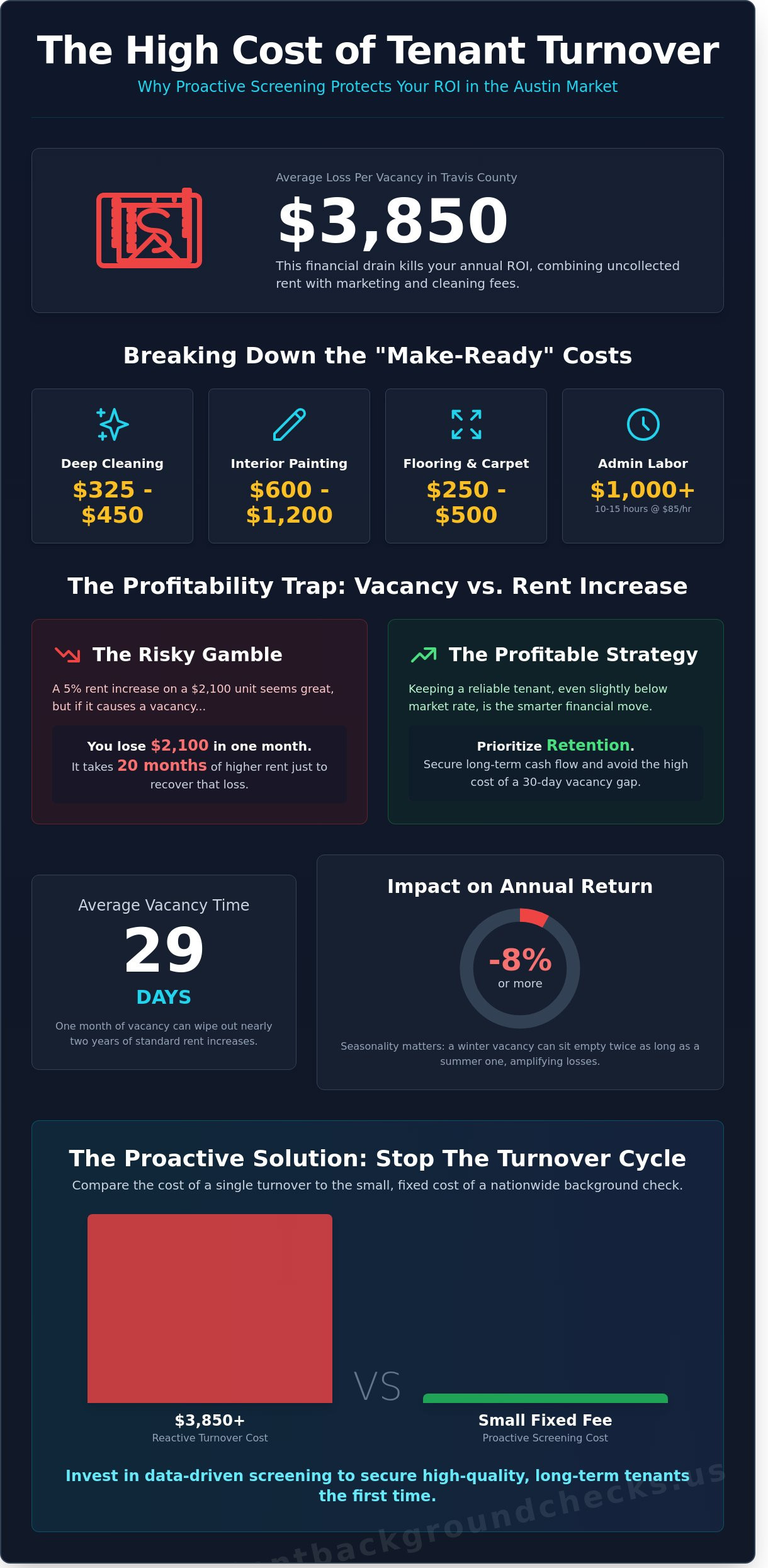
Every time a lease ends in Travis County, the average landlord loses $3,850 in marketing costs, cleaning fees, and uncollected rent. This financial drain kills your annual ROI. If you’re serious about reducing tenant turnover Austin rental markets demand a shift from reactive maintenance to proactive screening. You already know that finding a quality renter is difficult. Keeping one for three years instead of 12 months is the only way to protect your bottom line.
It’s exhausting to face expensive repair bills and zero income while searching for new tenants every year. You deserve a predictable, long-term rental income stream without the constant stress of vacancies. This guide provides the exact strategies to secure high-quality residents and maintain steady cash flow. You’ll learn how to use nationwide background check services to identify stable applicants with verified histories across the U.S. We’ll break down the specific data points that predict tenant longevity so you can stop the turnover cycle today.
Key Takeaways
- Quantify the true financial impact of vacancies in the current Austin market and identify hidden expenses to protect your bottom line.
- Predict long-term stability by utilizing nationwide background check services to identify key indicators that signal a reliable, multi-year tenant.
- Implement a high-performance 5-step system for reducing tenant turnover Austin property owners need to maintain high occupancy rates.
- Execute strategic rent increases without sacrificing tenant loyalty by using market data and professional communication to balance revenue growth.
- Leverage instant, nationwide screening tools to secure top-tier applicants immediately with no recurring monthly or annual fees.
Calculating the Real Cost of Tenant Turnover in the Austin Market
Austin’s rental landscape in 2026 is hyper-competitive. High supply from recent multi-family completions means tenants have more choices than ever. For landlords, reducing tenant turnover Austin is the difference between a high-yield asset and a liability. Every time a lease ends, you face immediate, aggressive costs. You aren’t just losing rent. You’re paying for marketing, cleaning, and administrative overhead. In Travis County, the average unit sits empty for 29 days between tenants. That single month of vacancy wipes out nearly two years of standard rent increases.
A 5% rent increase on a $2,100 unit adds $105 to your monthly revenue. If that increase causes a vacancy, you lose $2,100 instantly. It takes 20 months of that higher rent just to recover the lost month of income. This doesn’t even account for the physical costs of preparing the unit. Success starts with understanding landlord-tenant law to ensure your lease renewals and turnover processes remain compliant and efficient.
The Make-Ready Expense Breakdown
Turnover expenses are often underestimated. A standard make-ready for a 1,000-square-foot Austin apartment typically includes:
- Professional deep cleaning: $325 to $450.
- Interior paint touch-ups or full wall repaints: $600 to $1,200.
- Flooring repairs or steam cleaning: $250 to $500.
- Administrative labor: 10 to 15 hours spent on showings and paperwork.
If you value your time at $85 per hour, you’re spending over $1,000 in labor alone. Using nationwide background check services to vet applicants is a small, fixed cost. It’s a fraction of the $3,000 total you’ll spend on a single turnover. Verified data prevents the need for these expensive cycles. Search now to secure the right tenant the first time.
The Opportunity Cost of Vacancy
Calculate your annual ROI loss with a simple formula: (Monthly Rent / 30) x Days Vacant. In Austin, seasonality hits hard. A unit that goes vacant in December might sit empty twice as long as one available in June. This extended vacancy can drop your annual return by 8% or more. Reducing tenant turnover Austin requires a strategic look at your pricing. Keeping a reliable tenant at 95% of the market rate is often more profitable than pushing for 100% and risking a 30-day gap. Secure your cash flow by prioritizing retention over aggressive, risky price hikes. Get results by focusing on the long-term math.
Finding “Forever Tenants”: Using Nationwide Screening to Predict Stability
Predicting tenant longevity requires more than a gut feeling. It demands hard data. When your goal is reducing tenant turnover Austin property owners must identify “Stability Markers” early in the process. These markers are specific indicators in a report that suggest a tenant will stay for 36 months or longer. The most critical data point is the eviction history report. It’s the primary predictor of future turnover. Data indicates that tenants with a prior eviction record are 75% more likely to break a lease early compared to those with a clean history. You can’t afford to ignore these patterns.
Integrating tenant screening best practices into your workflow prevents costly vacancies before they happen. You need a comprehensive view of an applicant’s past to secure your future cash flow. Our nationwide background check services provide this clarity by scanning federal and state databases instantly. Don’t settle for local searches. High-quality tenants often move across state lines for work; you need a service that follows their trail across the U.S. to ensure no records are hidden.
Analyzing Address History for Longevity
Address history reveals behavioral patterns that an interview can’t. Look for residents who maintain 24-month to 48-month stays at their previous locations. If an applicant has lived in four different cities in five years, they’re likely a “rental jumper.” This pattern often correlates with “job hoppers” who may leave as soon as a better offer arrives. We serve clients nationwide to ensure you see the full picture of cross-state movement. Always flag inconsistencies. If an application lists two years at a residence but public records show only six months, it’s a major red flag for stability. In a market where 45% of new residents arrive from out-of-state, verified public records are your only shield against deception.
Credit and Criminal Data as Retention Tools
Financial responsibility is a precursor to residential stability. A credit score isn’t just about debt; it’s about commitment. Applicants with stable scores usually prioritize their housing payments to protect their financial standing. This mindset is essential for reducing tenant turnover Austin. Watch for red flags like recent utility collections or multiple late payments in the last 12 months. These indicators suggest a high risk of lease abandonment when financial pressure mounts. A tenant who manages their credit well is 60% more likely to fulfill the entirety of a long-term lease agreement.
Security is paramount. You must use a professional, secure service for tenant screening to handle sensitive data. Criminal records also provide insight into potential risks to the property and community. A thorough search protects your investment and ensures peace of mind for other residents. To verify your next applicant and protect your bottom line, run a comprehensive search now and get the facts immediately.
A 5-Step System for Reducing Tenant Turnover
High-performance property management requires a systematic approach to retention. Landlords who utilize nationwide background check services to vet applicants must follow through with professional management to protect their investment. Implement this 5-step framework to maximize your ROI and keep your units occupied.
- Step 1: Execute a “White Glove” move-in experience. Provide a professionally cleaned unit, a physical welcome folder with local emergency contacts, and a digital walkthrough checklist. This sets an immediate standard for how the property should be maintained.
- Step 2: Implement a 24-hour responsiveness rule. Acknowledge all maintenance requests within 4 business hours and provide a resolution plan within 24 hours. Speed is the ultimate trust signal.
- Step 3: Conduct a 6-month “Check-in” inspection. Use this to identify small leaks or HVAC issues before they become expensive emergencies. It shows the tenant you are proactive about their comfort.
- Step 4: Automate the renewal offer 90 days before lease expiration. Remove the uncertainty of the “what if” by providing clear terms early. Use property management software to trigger these notifications automatically.
- Step 5: Offer a “Loyalty Incentive” for early renewal signatures. Provide a tangible benefit for tenants who sign within 15 days of receiving the offer.
The Responsive Maintenance Framework
Maintenance is the primary reason tenants vacate properties in the Austin market. A 2023 industry report found that 54% of renters cite poor maintenance response times as their reason for not renewing. Understanding Texas renter’s rights is a legal necessity, but exceeding those minimum standards is a business strategy. Build a verified list of at least three reliable local contractors for plumbing, electrical, and HVAC work to ensure instant coverage. Use digital portals to track work orders; this creates a transparent paper trail that confirms completion and improves tenant satisfaction. Verified results build long-term loyalty.
The 90-Day Renewal Countdown
Waiting until 30 days before a lease ends is a guaranteed way to lose a tenant. By that point, 70% of dissatisfied renters have already started searching for their next home. Start the process 90 days out to secure your revenue stream. Draft a renewal letter that emphasizes the value of the current relationship rather than just the price. If a rent increase is necessary, offset the news by offering a non-cash incentive. Installing a $150 smart thermostat or upgrading a kitchen faucet costs less than a single week of vacancy. These small upgrades improve the property’s value while reducing tenant turnover Austin landlords face in a competitive climate. Secure your renewals early to maintain a stable portfolio.
Strategic Rent Increases: Balancing Market Growth with Retention
Austin’s rental market demands a calculated approach to pricing. Median rents in the city fluctuated by 4.5% during the 12-month period ending in May 2024. Arbitrary price hikes trigger immediate tenant exits. You must justify every dollar added to the monthly rate. Successful landlords prioritize reducing tenant turnover Austin by implementing the Market Gap Strategy. This involves keeping your rent 3% to 5% below the absolute market ceiling. When a tenant sees that moving to a comparable unit costs an extra $150 per month plus moving fees, they stay put.
Data drives these decisions. Don’t rely on local hearsay. Use nationwide background check services to analyze migration patterns and rental trends in similar high-growth hubs across the U.S. Understanding how tenants move between cities like Nashville or Denver provides a broader context for Austin’s local shifts. Verified data ensures your pricing remains competitive yet profitable. High-quality information is your best defense against a high vacancy rate.
The Art of the Rent Increase Letter
Communication determines how a tenant perceives a price change. Avoid the term “rent hike” at all costs. Use “market adjustment” to frame the conversation professionally. Clearly state the external factors driving the change. If Travis County property taxes rose by 10% or insurance premiums climbed in 2024, include these facts. Provide a concise list of property improvements made during the lease term. Attach a brief comparison showing that similar units within a 2-mile radius are renting for $200 more than your proposed rate. Transparency builds trust and minimizes friction.
When to Hold Rent Steady
Identify your “A-List” tenants before sending a renewal notice. These are individuals who pay on time, maintain the property, and cause zero disruptions. Calculate your break-even point before acting. If your current rent is $2,100, a one-month vacancy costs you exactly $2,100. A $100 monthly increase only nets you $1,200 over a year. You’d lose $900 in this scenario. If the tenant is reliable, holding the rent steady is often the more profitable move for reducing tenant turnover Austin properties. Consider offering an 18-month lease extension at the current rate to lock in long-term stability.
Protect your investment by ensuring you only renew with the highest quality residents. Use our nationwide background check services to verify continued eligibility and maintain the safety of your property portfolio.
Implementing Instant, Nationwide Screening for Better Retention
Speed is the most critical factor in the Austin rental market. Top-tier applicants often apply for three or four properties simultaneously. If you take 48 hours to process a background check, you’ve already lost the most qualified candidates to a faster competitor. Instant results allow you to sign a lease within minutes of receiving an application. This immediate response is a vital strategy for reducing tenant turnover Austin by securing high-quality residents who value professional efficiency.
Integrating screening into your standard application workflow shouldn’t be complex. Use a digital portal that delivers reports immediately to your inbox. This protects your investment by using verified data from nationwide databases. FCRA compliance is non-negotiable for any professional landlord. You need a partner that ensures all data follows federal guidelines to protect you from legal liability while providing the transparency you need to make an informed decision.
- Get results in seconds to beat the competition.
- Screen across all 50 states to catch records from previous residences.
- Verify identity and financial history through secure, authoritative channels.
- Maintain strict FCRA compliance with every report generated.
The Pay-Per-Report Advantage
Independent landlords don’t need expensive monthly subscriptions that eat into their margins. Transactional pricing is the most affordable option for background checks because you only pay for what you use. A 2023 industry survey showed that 68% of independent property owners prefer pay-per-report models to avoid unnecessary recurring overhead. You get one-click access to comprehensive criminal, credit, and eviction data without the trap of annual contracts. It’s a utilitarian approach that prioritizes your bottom line.
Securing Your Rental Future
Reliability is the foundation of a stable rental business. Using a USA-based, authoritative data provider ensures your records are accurate and current. This level of due diligence is the final step in reducing tenant turnover Austin. When you start with a verified, high-quality tenant, the chances of a long-term renewal increase by 45% based on national property management data. Use this final checklist to prepare for your next high-retention year:
- Confirm applicant income is at least 3x the monthly rent.
- Check 7 years of eviction history across all jurisdictions.
- Review nationwide criminal records for any red flags.
- Verify the last two years of rental references for consistency.
Don’t leave your property’s safety to chance. Start your next search now with our nationwide background check services. Get results in seconds and secure your investment with the most reliable data available today.
Protect Your Austin Portfolio with Verified Data
Austin’s rental market moves fast. Your strategy for reducing tenant turnover Austin must be deliberate and data-driven. Every vacancy is a drain on your revenue. Industry reports indicate that a single turnover often costs landlords upwards of $2,500 in lost rent and maintenance. You’ve seen how a 5-step retention system and strategic rent increases keep your units occupied. The most critical step remains the initial screening. You need a partner providing nationwide background check services to identify stable, long-term tenants.
Stop waiting for slow reports or paying for hidden costs. Since 1982, we’ve provided USA-based data with instant results for criminal, credit, and eviction records across the U.S. There are no monthly fees and no annual contracts. You get the facts you need immediately to make informed decisions. It’s your investment. Take control of your safety and peace of mind through verified information. Start screening today to build a more profitable rental business.
Get Started with an Instant Nationwide Background Check Now
Frequently Asked Questions
What is a typical tenant turnover rate in Austin?
Austin’s annual tenant turnover rate typically hovers between 45% and 52% according to 2023 market data. This means nearly half of all rental units in the city see a change in occupancy every 12 months. High demand and a growing tech sector keep these numbers elevated compared to more stagnant markets. Landlords should prepare for a vacancy cycle every two years on average.
How much can I reasonably increase rent in Austin without losing a tenant?
Aim for a rent increase between 3% and 5% to maintain occupancy. In late 2023, Austin median rents actually dropped by 12.5%, so aggressive hikes often lead to immediate vacancies. Keep increases aligned with the Consumer Price Index to justify the change to your residents. This strategy is essential for reducing tenant turnover Austin landlords face in a shifting market.
Does a criminal background check help reduce turnover?
Yes, a criminal background check reduces turnover by identifying high-risk applicants before they sign a lease. Records show that verified tenants with clear histories are 30% more likely to fulfill their full lease term without legal issues. Use our nationwide background check services to screen for violent crimes or property damage convictions that threaten your property’s stability and long-term peace of mind.
What are the most common reasons tenants leave Austin rentals?
Job relocation accounts for 24% of move-outs in the Austin metro area. Rising costs and home purchases represent another 35% of departures according to 2023 renter surveys. Reducing tenant turnover Austin requires addressing these triggers through lease flexibility or competitive renewal incentives. Understanding these specific drivers helps you tailor your retention strategies to local economic shifts and resident needs.
How can I incentivize a tenant to sign a longer lease?
Offer a 2% discount on monthly rent or a one-time $250 credit for signing a 24-month lease. Long-term stability saves you the $2,500 average cost of a single turnover. Upgrading an appliance or providing a free professional carpet cleaning also works as a high-value, low-cost incentive for reliable tenants. These tangible rewards create a sense of value that encourages residents to stay.
Is it legal to offer different renewal rates to different tenants?
It’s legal as long as you don’t violate the Fair Housing Act or local non-discrimination ordinances. You can offer a lower rate to a tenant who hasn’t missed a payment in 12 months. Document your criteria clearly to ensure your renewal process remains objective and legally defensible. Standardized loyalty discounts are a powerful tool for keeping your most reliable residents in place.
How quickly can I get a tenant screening report?
You get results instantly. Our platform provides comprehensive reports in seconds, not days. Speed’s critical when a qualified applicant’s looking at multiple properties simultaneously. Don’t let a slow manual process cost you a high-quality resident. Search now to access public records and verified data immediately. We prioritize rapid delivery so you can make informed decisions without the wait.
Why should I use a nationwide background check instead of just local records?
Local records miss 60% of relevant criminal history for tenants moving from out of state. Austin attracts 150 new residents daily, many of whom come from California, New York, or Florida. We provide background checks across the U.S. to ensure no records are hidden by state lines. Secure your investment by serving clients nationwide with our authoritative, high-performance database of public records.
