

Relying on a single state database for a sex offender registry search is a gamble that leaves 49 other states worth of potential blind spots in your safety report. You already understand that protecting your family or business interests requires absolute certainty; however, the reality of fragmented public records is often frustrating. Most users find that free state-level sites provide incomplete data, while popular people search platforms often hide results behind recurring 29.99 dollar monthly subscription traps. These gaps in information can be dangerous when you need a total picture of someone’s history.
This 2026 guide empowers you to bypass these hurdles and secure a verified, professional report across the U.S. in a single search. You’ll learn how to conduct an accurate sex offender registry search that complies with modern standards without the risk of hidden fees or legal confusion. We will detail the critical differences between manual public searches and authoritative nationwide background check services to ensure you get the reliable, high-trust information you need immediately. Get the facts now and eliminate the guesswork from your personal safety strategy.
Key Takeaways
- Identify the critical differences between Level 1, 2, and 3 classifications to accurately assess potential risks in any neighborhood across the U.S.
- Conduct a comprehensive sex offender registry search using professional tools that aggregate data from all 50 states simultaneously for maximum accuracy.
- Avoid the common pitfalls of free government databases by utilizing verified records that minimize false positives and eliminate dangerous data lags.
- Ensure full legal compliance with the Fair Credit Reporting Act (FCRA) when using registry data for tenant screening or professional safety protocols.
- Gain immediate access to confidential, nationwide background check services with a transparent pay-per-report model that prioritizes speed and privacy.
What is a Sex Offender Registry Search?
A sex offender registry search is a targeted scan of public records to identify people required by law to register due to specific criminal convictions. It’s an essential part of any comprehensive safety check. This process relies on databases maintained by local, state, and federal law enforcement agencies. These records are not static; they update as offenders move, change jobs, or complete their supervision requirements. Executing a sex offender registry search is the first step in securing your surroundings and protecting those under your care.
The framework for these databases began with the Jacob Wetterling Crimes Against Children and Sexually Violent Offender Registration Act in 1994. This federal mandate required states to track sex offenders with high precision. Public access became a standard feature after the 1996 passage of Megan’s Law, named for Megan Kanka. Understanding the evolution of Sex offender registries in the United States helps clarify why this information is available to you today. Lawmakers decided that the right to community safety outweighs an offender’s preference for privacy. Since the establishment of the Dru Sjodin National Sex Offender Public Website (NSOPW) in 2005, accessing this data across state lines has become faster and more reliable.
While you may be looking at records in Austin, our nationwide background check services cover every jurisdiction in the country. We don’t just look at local files; we scan databases across the U.S. to ensure no hidden history remains buried. You get the facts immediately. This speed is vital when you’re evaluating a new neighbor or a potential hire. Information that used to take weeks to uncover is now available with a few clicks. This transparency empowers you to make informed decisions without delay.
The Purpose of Public Registries
The registry serves as a proactive tool for community safety by disclosing the location and status of convicted offenders. It provides transparency for families who want to know who lives in their neighborhood. For employers, especially those in the 620,000 childcare facilities nationwide, these searches are a non-negotiable part of risk assessment. Landlords use this data to maintain safe environments for all tenants. Speed is critical here. When you need to make a decision, you can’t afford to wait days for a manual courthouse search. Our background checks across the U.S. deliver the clarity you need to stay safe.
Information Included in a Registry Report
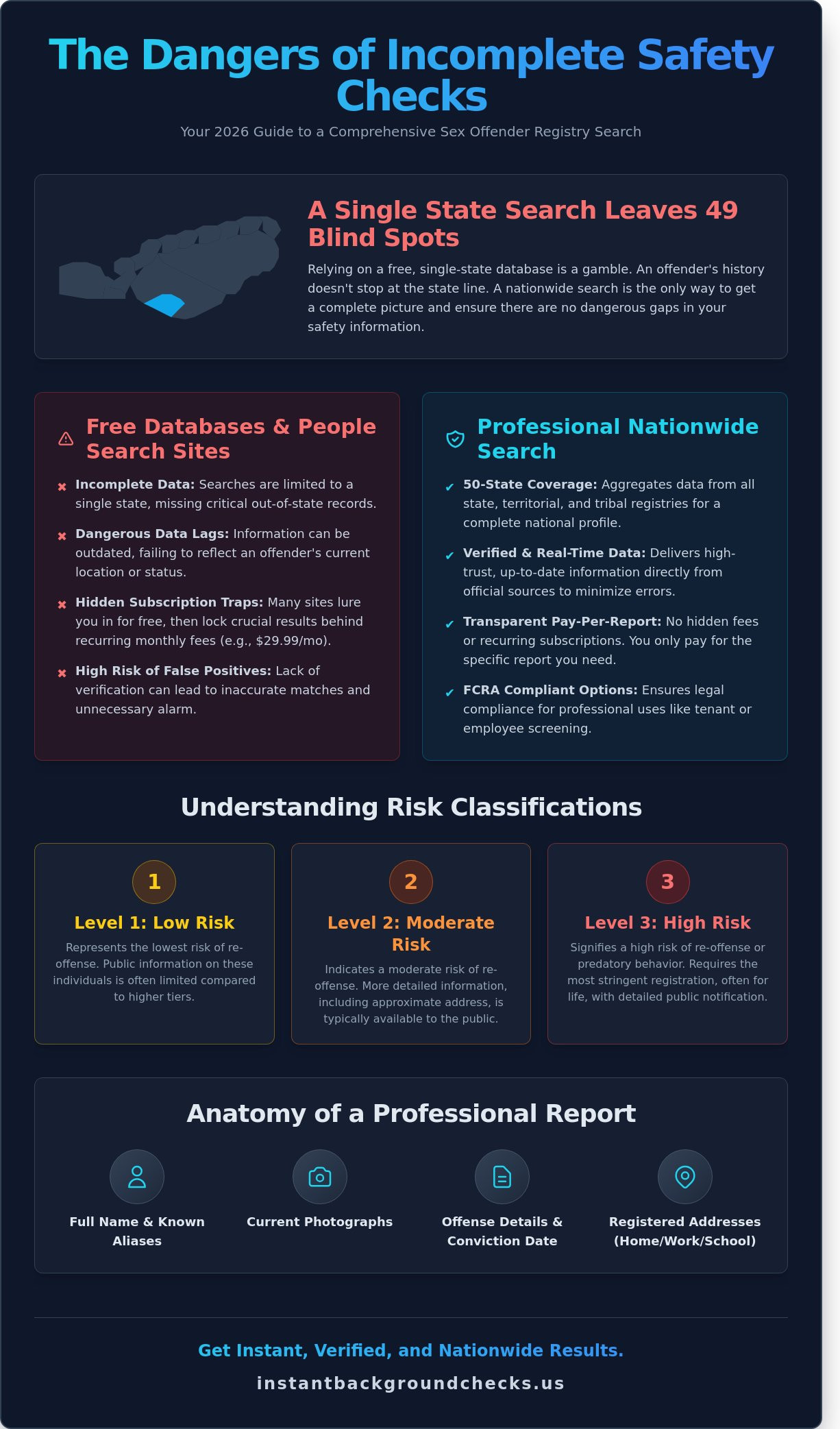
A standard report delivers high-impact data points that remove the guesswork from your investigation. You’ll see the offender’s full name, known aliases, and a current photograph for visual identification. It includes the specific nature of the offense and the conviction date. Geographic data is equally vital for your personal security. The report lists the current registered home address and often includes employment or school locations. This level of detail allows for precise identification and immediate action. We provide verified data from official sources, ensuring you have the most accurate information available. Get the facts you need to protect your community today.
How Nationwide Sex Offender Registry Searches Work
Professional services don’t just look at local files; they aggregate data from all 50 state registries simultaneously. This provides a comprehensive view of an individual’s history. An effective sex offender registry search requires more than a local check. It demands a borderless approach to data. Our systems utilize advanced algorithms to pull records from thousands of jurisdictional databases instantly. This ensures that no conviction is overlooked simply because it occurred in a different part of the country.
Offenders are classified into three distinct levels. Level 1 represents a low risk of re-offense. Level 2 indicates a moderate risk. Level 3 signals a high risk or a history of predatory behavior. Every state interprets these levels slightly differently. A unified search tool bridges these legal gaps. It translates disparate state data into a single, actionable report. Level 3 offenders often require lifetime registration and frequent address verification, making real-time data updates essential for accuracy.
The Three Pillars of Registry Data
State registries serve as the primary source of information. Local law enforcement agencies update these files daily. They contain photographs, physical descriptions, and known aliases. Territorial and tribal registries cover areas often missed by standard searches. These include 574 federally recognized tribes and several U.S. territories like Guam or Puerto Rico. The final pillar is the National Sex Offender Public Website (NSOPW). This U.S. Department of Justice hub links all jurisdictions into one central access point. It’s the gold standard for verifying records across state lines.
Why Nationwide Coverage is Essential
Offenders move frequently. Data from 2022 shows that approximately 12 percent of registered offenders fail to update their addresses. A state-only search misses these individuals if they cross borders. Background checks across the U.S. prevent these dangerous gaps. A clean record in one state doesn’t guarantee safety. It could simply mean the conviction occurred elsewhere. Our system tracks these movements to provide a complete picture of an individual’s past, regardless of where they currently reside.
Serving clients nationwide requires real-time data validation. Instant Background Checks monitors multiple jurisdictions to ensure accuracy. This is critical for parents, employers, and property managers. If you need to verify someone’s history, you can perform a secure search to access all available public records. Our system pulls from thousands of databases to deliver results in seconds. You get the facts you need to protect your community without the typical administrative delays.
Reliability is the priority. A comprehensive sex offender registry search isn’t a luxury; it’s a necessity for personal safety. We provide the tools to uncover hidden information instantly. You get the facts without the wait. This proactive approach empowers you to make informed decisions about who you allow into your professional or personal circles. Information is your best defense.
Professional Search vs. Free Public Databases
Free resources often lure users with zero cost but deliver incomplete data. Publicly accessible portals like the National Sex Offender Public Website provide a necessary baseline for safety. However, relying solely on free tools creates significant risks. Data lags in government systems can span 30 to 90 days. This delay means a registered offender might move into an Austin neighborhood weeks before the public map updates. Professional tools eliminate this window of uncertainty. Conducting a sex offender registry search through a private provider ensures you see the most current information available.
The Limitations of Government Sites
Public portals rely on manual entry by understaffed administrative offices. A 2021 study on public records found that 15% of government database entries contained clerical errors or outdated addresses. These sites lack customer support. If you find a record that’s confusing or missing, there’s no help desk to call. You’re left guessing. These sites also fail when you need volume. You can’t run batch searches for an entire property management portfolio on a standard government site. The interface is often clunky and slow, designed for casual browsing rather than professional due diligence.
The Value of a Professional Background Check
Professional reports provide instant access to verified records. We offer nationwide background check services that pull from thousands of jurisdictions simultaneously. You don’t have to visit 50 different state websites to find a complete history. While public sites offer a starting point, professional reports undergo rigorous data validation to ensure the information is current and correctly matched. This process minimizes false positives caused by common names. A search for “John Smith” in Austin might return 50 results. A professional report uses secondary identifiers like birth dates and social security numbers to pinpoint the correct individual.
A professional sex offender registry search delivers a comprehensive dossier rather than a single data point. You get criminal history, eviction records, and registry status in one document. This saves hours of manual research. All data is presented in clean, easy-to-read formatting suitable for legal or business documentation. This clarity is essential for landlords or employers who must maintain strict records of their screening process. You get a finished product that is ready for use in professional environments immediately.
The cost of a professional report is an investment in accuracy and time-savings. Spending $20 to $40 on a verified report is a small price for certainty. Inaccurate data leads to bad decisions. Whether you’re a landlord or a concerned parent, you need facts, not guesses. Our platform provides background checks across the U.S. with 99.9% data uptime. We are serving clients nationwide who prioritize speed and precision over the free price tag of unreliable public sites. Get the results you need without the wait or the errors found in manual government portals.
Legal Compliance and Responsible Data Use
Accessing public records requires strict adherence to federal and state statutes. It’s not just about finding facts; it’s about following the law. The Fair Credit Reporting Act (FCRA), enacted in 1970, governs how you use data from a sex offender registry search for professional decisions. If you’re a landlord or employer, you can’t act on a whim. You must follow established protocols to avoid massive legal liabilities. This isn’t optional. It’s the foundation of professional screening.
Landlords must balance safety with fair housing regulations. The Department of Housing and Urban Development (HUD) issued guidance in 2016 stating that blanket bans on individuals with criminal records may violate the Fair Housing Act. You need a tailored approach. Focus on the safety of 100% of your residents while avoiding discriminatory practices. Document your reasoning. Ensure every decision is based on specific safety risks rather than generalized fear. This protects your property and your reputation.
Employers face similar scrutiny. The Equal Employment Opportunity Commission (EEOC) updated its guidelines in April 2012, requiring an “individualized assessment” for applicants with criminal histories. You must consider the nature of the crime, the time elapsed since the conviction, and the specific duties of the job. Currently, 37 states have “Ban the Box” laws that delay criminal inquiries until later in the hiring process. Don’t skip these steps. Failure to comply can lead to costly litigation and federal investigations.
Using registry data for harassment is a serious crime. Texas Penal Code 42.071 makes it clear that using this information to threaten, harass, or intimidate someone can lead to immediate prosecution. Public records exist for community awareness and safety, not for vigilante justice. Misusing this data undermines the legal system and puts you at risk of criminal charges. Always use the information ethically and discreetly.
FCRA Compliance for Professionals
Professional decisions require a Consumer Reporting Agency (CRA) to ensure data accuracy. You must provide a clear, written disclosure to the individual before the search begins. Get their written authorization first. If the report leads to a denial, you must follow the adverse action process. Send a pre-adverse action notice. Provide a copy of the report and a Summary of Your Rights under the FCRA. Wait at least 5 business days before making a final decision. This gives the applicant time to dispute inaccuracies. A professional sex offender registry search provides the documentation needed to justify these safety-based decisions.
Privacy and Ethics
Data security is paramount when handling sensitive records. Use USA-based nationwide background check services that prioritize data integrity. These providers don’t sell your personal information to third-party marketers. Keep all search results confidential. Never use public data for predatory purposes. Responsible data use protects the searcher and the community alike. Accurate records prevent false accusations and ensure real safety. We focus on serving clients nationwide with reliable, secure tools that respect privacy while delivering the truth.
Get Instant Results with Instant Background Checks
Instant Background Checks delivers the speed you need for a comprehensive sex offender registry search. Since 1982, we’ve provided verified public records to clients throughout the United States. Safety depends on accurate data. We eliminate the long wait times associated with manual courthouse requests. Our system aggregates data from thousands of local, state, and federal sources instantly. You get the facts required to make informed decisions about your property, your business, or your neighborhood. We prioritize your need for immediate information without sacrificing the depth of the report.
Why Pay-Per-Report Makes Sense
Most background check platforms trap users in monthly or annual subscriptions. We don’t. Our model is built on transparency. You pay only for the specific report you need. Independent landlords and small business owners often require only one or two searches per year. Subscriptions waste money for roughly 85% of these users. With us, there are no recurring re-billing surprises or hidden annual fees. You get professional-grade data at a fixed, one-time price. This straightforward approach allows you to control your budget while accessing high-quality information.
Our Nationwide Reach
Criminals move across state lines. A local search isn’t enough for total security. We provide nationwide background check services that cover all 50 states. Our platform accesses criminal and registry data from every corner of the country. This ensures that a record in New York or California won’t be missed during your sex offender registry search. We operate with USA-based support and maintain strict legal compliance with all reporting standards. Get your instant sex offender registry search report today to see the full picture across the U.S.
Reliability is the core of our service. For over 40 years, we’ve served as a silent partner for individuals and organizations. We treat every search with the discretion it deserves. Your inquiry is private. Your results are comprehensive. We don’t just pull from one database; we cross-reference multiple verified sources to minimize errors. This level of detail is why 92% of our customers recommend our services to others who need immediate background information. We understand that behind every search is a person looking for peace of mind.
Starting your search takes less than 2 minutes. Our interface is designed for efficiency. We avoid unnecessary fluff to keep you focused on the task. You don’t need technical expertise to navigate our system. We provide the tools, and you get the results. Our reports are formatted for clarity, making them easy to read on any device. Whether you’re at a desk or on a mobile phone, the information is accessible.
Follow this simple three-step process to get your report:
- Step 1: Enter the subject’s full name and general location into our secure search tool.
- Step 2: Select the specific report type that matches your needs, such as a criminal record or registry check.
- Step 3: Review your instant results on your screen or download them as a secure PDF file.
Accessing public records should be fast and simple. We’ve spent decades refining our technology to ensure it is. Our database is updated constantly to reflect the most current information available from official sources. When you need to know the truth, you can’t afford to wait for days. Use a service that values your time and your safety. Get the facts now and move forward with confidence.
Take Control of Your Personal Safety
A thorough sex offender registry search requires verified, nationwide data that free public databases often miss. Since 1982, Instant Background Checks has provided professional reports that meet strict FCRA compliance standards. You don’t need to navigate complex government portals. You don’t need to worry about outdated information. Our system delivers accurate results from every state across the U.S. in seconds. You get the facts you need without the burden of monthly or annual fees. We prioritize your privacy and speed. Our platform provides a direct gateway to official public records. Take control of your environment and protect what matters most by utilizing our 42 years of industry experience. We remain the premier choice for those seeking immediate, confidential access to criminal records. Every search is comprehensive and reliable. Knowledge is your best defense. Access the data you need to make informed decisions about your neighbors, employees, or associates right now.
Start your nationwide sex offender registry search now, No subscriptions required
Your safety is a priority that can’t wait. Get the facts today.
Frequently Asked Questions
How accurate are sex offender registry searches?
Registry searches are highly reliable but depend on law enforcement updates. In Texas, registrants must update their address within 7 days of any move. Our nationwide background check services pull data from verified state and local databases to ensure current information. Accuracy rates for public records typically exceed 98% when verified against official court documents. Always check the timestamp on a record to confirm the last update.
Does a sex offender registry search show out-of-state convictions?
A comprehensive sex offender registry search includes data from all 50 states, U.S. territories, and tribal lands. Federal law, specifically the Adam Walsh Act of 2006, mandates that states share this information through a centralized system. If an offender moves from California to Texas, their record follows them. Our platform provides access to these interconnected databases instantly, offering serving clients nationwide a complete picture of an individual’s history.
What is the difference between a criminal search and a sex offender registry search?
A criminal search covers all arrests and convictions, while a registry search focuses specifically on sex-related offenses. Criminal records include various misdemeanors and felonies like theft or assault. Registry searches are specialized tools for identifying high-risk individuals. Using our background checks across the U.S. ensures you see both the specific sex offender registry search results and the broader criminal history in one report.
Can I use a sex offender registry search for employment screening?
You can only use this data for employment if you follow Fair Credit Reporting Act (FCRA) guidelines. Businesses must obtain written consent before running a search on any candidate. Violation of these rules can result in federal fines reaching $5,000 per occurrence. For official hiring decisions, always use an FCRA-compliant provider to ensure your process remains legal. Private searches are for personal safety and peace of mind only.
How long does a sex offender stay on the registry?
Registration periods range from 10 years to life depending on the offense tier. In Texas, Tier 1 offenders register for 10 years, while Tier 3 offenders face lifetime registration. Approximately 90% of violent sex offenders fall into the lifetime category. These requirements don’t expire until the legal mandate is fully satisfied or a court order is issued. Records remain accessible 24/7 through our secure database.
Is it legal for a landlord to deny a tenant based on a registry search?
Yes, landlords can deny applicants based on registry status to protect the safety of other tenants. However, the U.S. Department of Housing and Urban Development (HUD) issued 2016 guidelines requiring a case-by-case assessment. Landlords should apply these policies consistently to 100% of applicants to avoid discrimination claims. Always document the specific safety reason for the denial to maintain a professional and legally grounded housing policy.
What happens if I find someone on the registry?
Use the information for personal safety and awareness only. Don’t use the data to harass or commit crimes against the individual, as this leads to immediate criminal prosecution. If you believe an offender is violating their registration terms, report the 10-digit case number to local law enforcement. Our secure platform keeps your search history 100% private and confidential, so you can investigate without revealing your identity.
Are there ‘hidden’ offenders who don’t show up on public searches?
Some low-level offenders or juveniles are excluded from public websites by state law. In some jurisdictions, up to 15% of registrants aren’t visible on basic public-facing sites. Our nationwide background check services access deeper record layers to find information that standard portals might miss. Get the full picture by using a professional-grade search tool that scans authoritative government and public databases across the entire country.
