

Your rental property is a significant financial asset. The single greatest risk to that investment is a tenant who fails to pay rent. Navigating the screening process, however, is filled with legal complexities and uncertainty. You need accurate, reliable financial data to make a secure decision, but you cannot afford a compliance misstep. This is where a comprehensive tenant credit check becomes your most critical tool. Choosing the right applicant is not a guessing game; it is a matter of having the correct information, delivered instantly.
This complete 2026 guide provides the definitive process for landlords across the U.S. You will learn how to run a fully compliant screening that protects you from legal challenges. We reveal precisely what to look for in a credit report-from debt-to-income ratios to payment histories-and how to identify the financial red flags that signal future problems. Gain the confidence to select a financially responsible tenant and secure your rental income with verified data.
Key Takeaways
- Learn to assess an applicant’s financial responsibility to protect your property from risk.
- Identify the critical sections of a credit report and the FCRA rules you must follow to remain compliant.
- Go beyond the credit score to spot patterns of financial behavior-both positive and negative.
- Discover how to run a fast, legally compliant tenant credit check to get the data you need in minutes.
Why a Tenant Credit Check is a Non-Negotiable Screening Tool
A tenant credit check is not just a formality; it is a critical security measure for your rental property. This is a detailed report of an applicant’s financial history, pulling data on their debts, payment history, and relevant public records like bankruptcies. Its primary function is to give you a clear, verified picture of an applicant’s financial responsibility. With unpaid rent costing U.S. landlords billions of dollars annually, you cannot afford to guess. Relying on unverified methods like applicant-provided screenshots is a significant financial risk. A professional screening provides the accurate, instant data you need to protect your investment.
The True Cost of a Bad Tenant
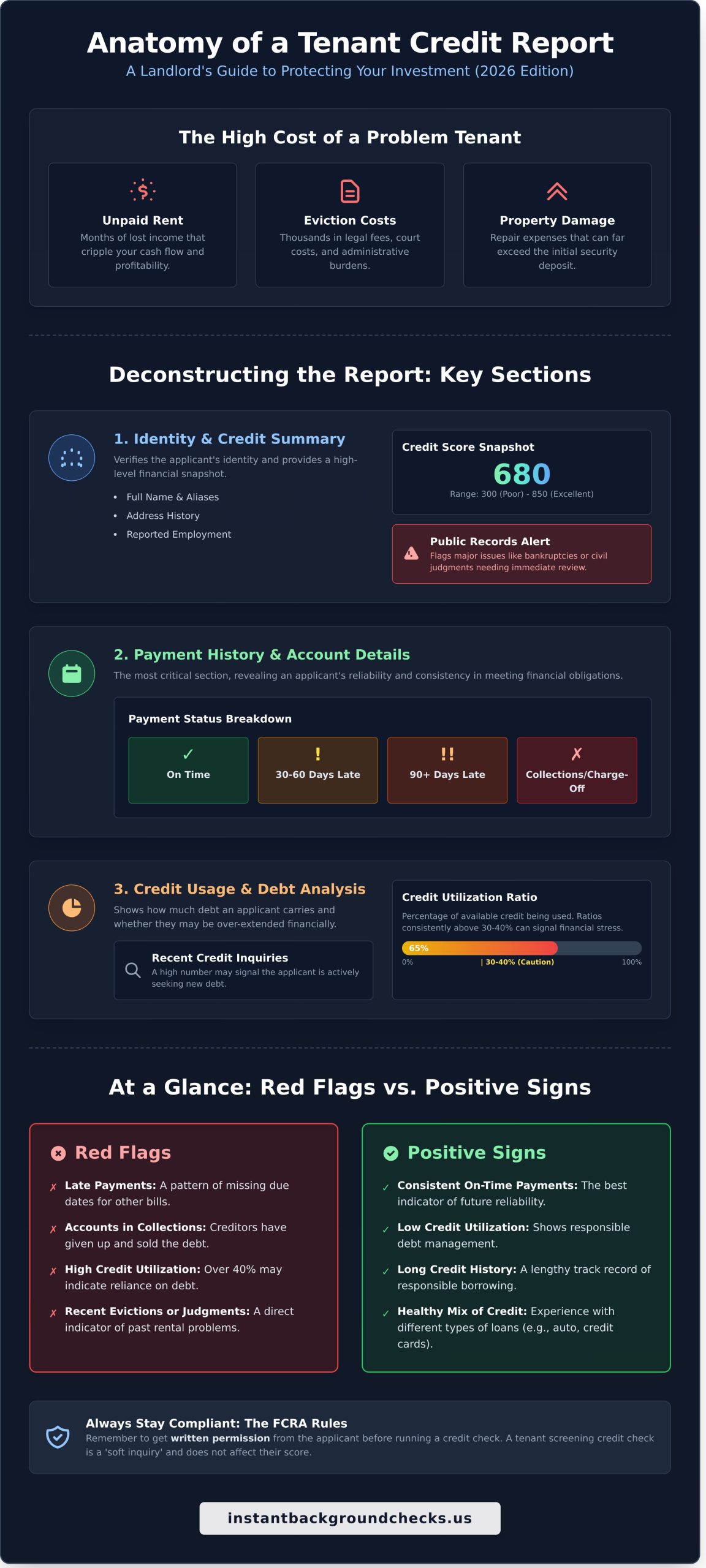
Placing the wrong tenant exposes your property to severe, cascading financial damage. The risks go far beyond a single missed payment. A problematic tenancy often leads to:
- Unpaid Rent: Months of lost income that can cripple your cash flow.
- Eviction Costs: Thousands of dollars in legal fees, court costs, and administrative hassle.
- Property Damage: Significant expenses for repairing damages that go well beyond the security deposit.
Beyond the direct financial hit, the eviction process itself is a major drain on your time and mental energy. A small, upfront investment in a comprehensive background and credit screening is the most effective way to prevent these catastrophic future losses and secure your peace of mind.
Beyond the Credit Score: What You’re Really Looking For
An applicant’s credit score is only a summary-a single number that cannot tell the whole story. To make a truly informed decision, you must look deeper into the full report. While it is essential to understand what a credit score is, the real insights are found in the financial patterns behind that number. A complete tenant credit check reveals the applicant’s history of responsibility. You are looking for consistency in payments, manageable debt levels, and the absence of major red flags like accounts in collections or recent evictions. This detailed view is far more valuable than any three-digit score for assessing an applicant’s true risk.
What’s Inside a Tenant Credit Report? A Detailed Breakdown
Think of a credit report not as a pass/fail grade, but as a financial resume. It provides a factual, comprehensive history of an applicant’s financial behavior. This data is compiled by the three major credit bureaus-Experian, Equifax, and TransUnion. Importantly, a tenant credit check is a ‘soft inquiry,’ meaning it is conducted with the applicant’s permission and does not impact their credit score.
A standard report is organized into three primary sections for efficient review:
- Identifying Information & Credit Summary: Verifies identity and provides a top-level financial snapshot.
- Payment History & Account Details: The core record of an applicant’s reliability with debt.
- Credit Usage & Debt Analysis: Shows how much debt the applicant carries relative to their available credit.
Identifying Information and Credit Summary
This section confirms the applicant’s identity with their full name, address history, and any reported employment. You will see a credit score, typically a FICO or VantageScore ranging from 300 to 850, offering a quick risk assessment. This summary also flags significant public records, such as bankruptcies or civil judgments, which require immediate attention during your evaluation.
Payment History and Account Details
Here, you will find a detailed list of all credit accounts: credit cards, auto loans, mortgages, and student loans. The most critical data point is the payment history. Look for late payments marked as 30, 60, or 90+ days past due. Also, identify any accounts sent to collections or listed as a ‘charge-off,’ which indicates the original creditor gave up on collecting the debt. This information is regulated, and landlords must comply with the Fair Credit Reporting Act when using it to make rental decisions.
Credit Usage and Debt Analysis
This part of the tenant credit check reveals an applicant’s total debt. Pay close attention to the credit utilization ratio-the percentage of available credit being used. A ratio consistently above 30-40% can be a red flag for financial stress. A high number of recent credit inquiries can also signal that the applicant is actively seeking new debt, which could impact their ability to pay rent consistently.
Staying Compliant: The FCRA Rules Every Landlord Must Know
Running a background check on a potential tenant is a critical step, but it is governed by strict federal law. The Fair Credit Reporting Act (FCRA) is the primary regulation dictating how landlords can access and use consumer reports. Compliance is not optional; it protects your business from significant legal penalties and ensures a fair, transparent process for every applicant. The core principle is “permissible purpose”-you must have a legitimate, business-related reason, initiated by the rental application, to view their credit history. Understanding what a credit report contains is only the first step; using that information correctly is paramount. To conduct a fully compliant tenant credit check, follow these three mandatory steps.
Step 1: Get Written Consent
You cannot legally access a consumer report without the applicant’s explicit, written permission. This consent must be a clear, standalone authorization, not buried in fine print. Modern, nationwide background check services streamline this requirement with a secure, tenant-initiated process. The applicant receives a private link to authorize the check, which creates a clear digital record of consent. Your paper or online rental application must include direct authorization language, such as: “I authorize [Your Name/Company Name] to obtain my consumer credit report and other background information for tenant screening purposes.”
Step 2: Use the Information for Tenancy Decisions Only
The data obtained from a credit report is confidential and legally protected. It can only be used to evaluate the rental application and for no other purpose. You cannot share this sensitive information with anyone outside of the tenancy decision process. It is your responsibility to securely store and properly destroy all applicant data to prevent breaches and identity theft. Furthermore, applying your screening criteria consistently to every applicant is a critical best practice that helps avoid potential discrimination claims and ensures fair housing compliance.
Step 3: Follow Adverse Action Procedures
If you deny an applicant, require a co-signer, or charge a higher deposit based wholly or partly on information in their report, this is an “adverse action.” The FCRA requires a specific two-step notification process. First, you must provide a “pre-adverse action notice.” This includes a copy of the report and a summary of their rights, giving the applicant a chance to review the data and dispute inaccuracies with the credit bureau. After a reasonable period, you may then send the final “adverse action notice” that officially states your decision.
How to Analyze a Report: Red Flags vs. Positive Signs
A tenant credit report provides raw data; your job is to interpret it. The most effective landlords establish clear, written rental criteria before they begin screening applicants. This practice ensures fair, consistent decisions and helps you comply with Fair Housing regulations. Focus on identifying patterns of financial behavior, not isolated mistakes. A single late payment from three years ago is far less concerning than a recent pattern of missed obligations.
Running a comprehensive tenant credit check is the first step; accurate analysis is the second. Use the following points to separate low-risk applicants from high-risk tenants.
Potential Red Flags to Investigate
- History of Late Payments: Consistent 30, 60, or 90-day late payments, especially to previous landlords or utility companies, signal a direct risk to your rental income stream.
- High Credit Utilization: Maxed-out credit cards or high balances relative to credit limits indicate financial distress. This leaves little room for emergencies, which could impact their ability to pay rent on time.
- Recent Negative Events: A pattern of accounts sent to collections, recent charge-offs, or a sudden flurry of newly opened credit lines demands further investigation and may suggest instability.
- Evictions and Judgments: A formal eviction history or a civil judgment from a previous landlord for unpaid rent is one of the most significant predictors of future rental problems.
Positive Signs of a Responsible Applicant
- Consistent On-Time Payments: A long and verifiable record of paying rent, mortgage, and other major bills on time is the strongest indicator of a reliable tenant who prioritizes their housing obligations.
- Low Credit Utilization: Applicants who use less than 30% of their available credit demonstrate sound financial management and the ability to live within their means.
- Healthy Credit Mix: A stable history of managing different types of credit (e.g., an auto loan, a credit card, a student loan) over several years shows financial maturity.
- Few Recent Inquiries: A low number of hard inquiries suggests the applicant is not actively seeking new lines of credit, a key sign of financial stability. For a full breakdown, see our guide on reading a tenant’s report.
Ultimately, a tenant credit check provides a detailed financial snapshot. By using objective criteria to weigh these signs, you empower yourself to make a confident, data-driven leasing decision. Get the complete picture with an instant, comprehensive report from InstantBackgroundChecks.us.
Run an Instant, Compliant Tenant Credit Check in Minutes
Austin landlords operate in a fast-paced market. You need reliable, legally sound data to make critical decisions without delay. Waiting for slow, complex screening services creates risk and costs you valuable time. The challenge is clear: access comprehensive applicant data that is both immediate and fully compliant with federal regulations.
InstantBackgroundChecks.us provides a direct solution. We deliver nationwide background check services designed for the modern landlord. Our pay-per-report model means you never pay for subscriptions or monthly fees. Order a report only when you need one. This makes our service ideal for independent property owners and managers who require flexibility and control over their expenses.
Our entire process is streamlined for security and efficiency. The screening is tenant-initiated, meaning the applicant provides direct consent and enters their own sensitive information into our secure portal. This removes your liability for handling private data and automates the required legal authorization, giving you the verified information you need to move forward with confidence.
The Advantage of Our Nationwide Service
Get the complete picture on any applicant from across the U.S. Our system provides a decisive advantage by consolidating critical data into one easy-to-read report. You gain immediate access to:
- Comprehensive History: A full credit report with payment history, a nationwide criminal background check, and a detailed eviction history report.
- FCRA Compliance: Our process is fully compliant with the Fair Credit Reporting Act (FCRA), protecting you from legal risk and ensuring fair screening practices.
- Instant Results: Once the applicant authorizes the request, the complete report is delivered to your secure online dashboard in minutes.
How to Order Your First Report
Executing a professional tenant credit check is a simple, three-step process. Our platform is designed for immediate action, allowing you to screen an applicant today without any setup fees or long-term commitments.
- Create Your Free Account: Sign up in seconds. There are no subscriptions or hidden monthly costs. You only pay for the reports you order.
- Send the Screening Request: Enter your applicant’s name and email address. We immediately send them a secure link to authorize the background check.
- Receive the Instant Report: The applicant completes the authorization online. Their verified, comprehensive report is sent directly to your account for review.
Protect your investment. Start your tenant screening now.
Secure Your Asset: Finalize Your Screening with Confidence
Your property is a significant investment. Protecting it starts with selecting the right tenant. As this guide demonstrates, a comprehensive tenant credit check is not optional-it is the most effective tool for assessing an applicant’s financial responsibility. By understanding the report’s contents and adhering strictly to FCRA guidelines, you mitigate risk and make data-driven decisions.
Don’t base your choice on intuition. Verify it with facts. Instant Background Checks has served landlords nationwide since 1982, offering a fully FCRA-compliant process without demanding subscriptions. You only pay per report, giving you complete control over your screening costs.
The information you need is available now. Take decisive action to protect your rental income and property value. Get a Fast, Compliant Tenant Credit Report Now and rent with total confidence.
Frequently Asked Questions
What is a good credit score for a tenant in 2026?
Most landlords nationwide look for a credit score of 670 or higher. In competitive rental markets, a score above 700 may be required to stand out. While this is a general benchmark, landlords often consider the entire financial profile, including payment history and debt-to-income ratio. A lower score is not an automatic disqualification but requires closer review of the full credit report to assess risk and ensure financial responsibility.
Can a landlord run a credit check without the applicant’s permission?
No. Federal law, specifically the Fair Credit Reporting Act (FCRA), strictly prohibits running a credit check without the applicant’s explicit written consent. You must obtain a signed authorization form before accessing their credit information. Proceeding without permission is illegal and exposes you to significant legal penalties. Always secure consent through a secure platform to maintain full legal compliance and protect your business.
How much does a tenant credit check cost?
The cost for a tenant credit check typically ranges from $25 to $75 per applicant. The final price depends on the provider and the comprehensiveness of the report. Some services bundle the credit check with other screenings, such as criminal background and eviction history reports. Landlords can often pass this fee on to the applicant as part of the application fee, but must comply with state and local laws regarding the amount and disclosure.
Does running a credit check for an apartment hurt the applicant’s score?
It depends on the type of inquiry used. Most modern tenant screening services use a “soft pull,” which does not impact the applicant’s credit score. This allows you to view their credit history without causing harm. However, some landlords may use a “hard pull,” which can temporarily lower the score by a few points. Applicants should always clarify which type of inquiry will be performed before giving consent to the screening.
What is the difference between a credit check and a full background check?
A tenant credit check focuses exclusively on an applicant’s financial history, including their credit score, debt, and payment patterns. A comprehensive background check is much broader. It includes the credit report plus critical data like nationwide criminal records, eviction history, and employment verification. For a complete risk assessment, a full background check provides the most detailed and actionable intelligence on a potential tenant, ensuring you have a complete picture.
How long does it take to get a tenant credit report?
With modern screening services, results are typically instant. Once the applicant provides their consent and information through a secure online portal, the credit report is generated and delivered to you in minutes. This immediate access to verified data allows you to accelerate your decision-making process and secure qualified tenants quickly. Eliminate delays and get the information you need, when you need it, with our background checks across the U.S.
What should I do if an applicant has no credit history?
An applicant with no credit history, often called a “thin file,” is not the same as one with bad credit. Do not automatically deny them. Instead, request alternative evidence of financial responsibility. This can include bank statements showing consistent income and savings, proof of rent payments from a previous landlord, or a letter of employment verifying salary. You may also consider requiring a qualified co-signer or a larger security deposit to mitigate potential risk.
Can I deny a tenant for bad credit?
Yes, you can legally deny an applicant based on information in their credit report, provided you apply your screening criteria consistently to all applicants. If you deny someone due to their credit, the FCRA requires you to provide them with an “adverse action notice.” This notice must state the reason for denial and provide the name and contact information of the credit reporting agency that supplied the report, allowing the applicant to obtain a free copy.