

Hiring or renting in Texas? The line between a smart decision and a legal liability is thin. Conducting a proper background check texas residents requires more than just a simple search-it demands a precise understanding of state laws, public records, and the different screening services available. Without the right knowledge, you risk violating complex regulations, relying on incomplete data, and making a costly mistake. The fear of non-compliance and the confusion over where to find accurate information can be paralyzing.
This guide eliminates the uncertainty. We provide the definitive roadmap for getting a comprehensive, instant, and legally compliant background check. You will learn the critical differences between state-run DPS searches and private, commercial services. We detail exactly what information is legally accessible-from criminal histories to eviction records-and how to access it quickly. Find a cost-effective, pay-per-use solution and get the verified information you need to make safe, confident decisions while ensuring full compliance with all Texas and federal laws.
Key Takeaways
- Access a comprehensive range of Texas public records, from criminal history to court filings, to uncover the complete story.
- Learn the critical differences between official state sources and private services to get the fastest, most accurate results.
- A legally compliant background check texas requires strict adherence to state and federal FCRA laws to avoid severe penalties.
- Decipher complex report data to instantly identify the critical red flags that matter for your employment or tenant screening.
What’s Included in a Texas Background Check?
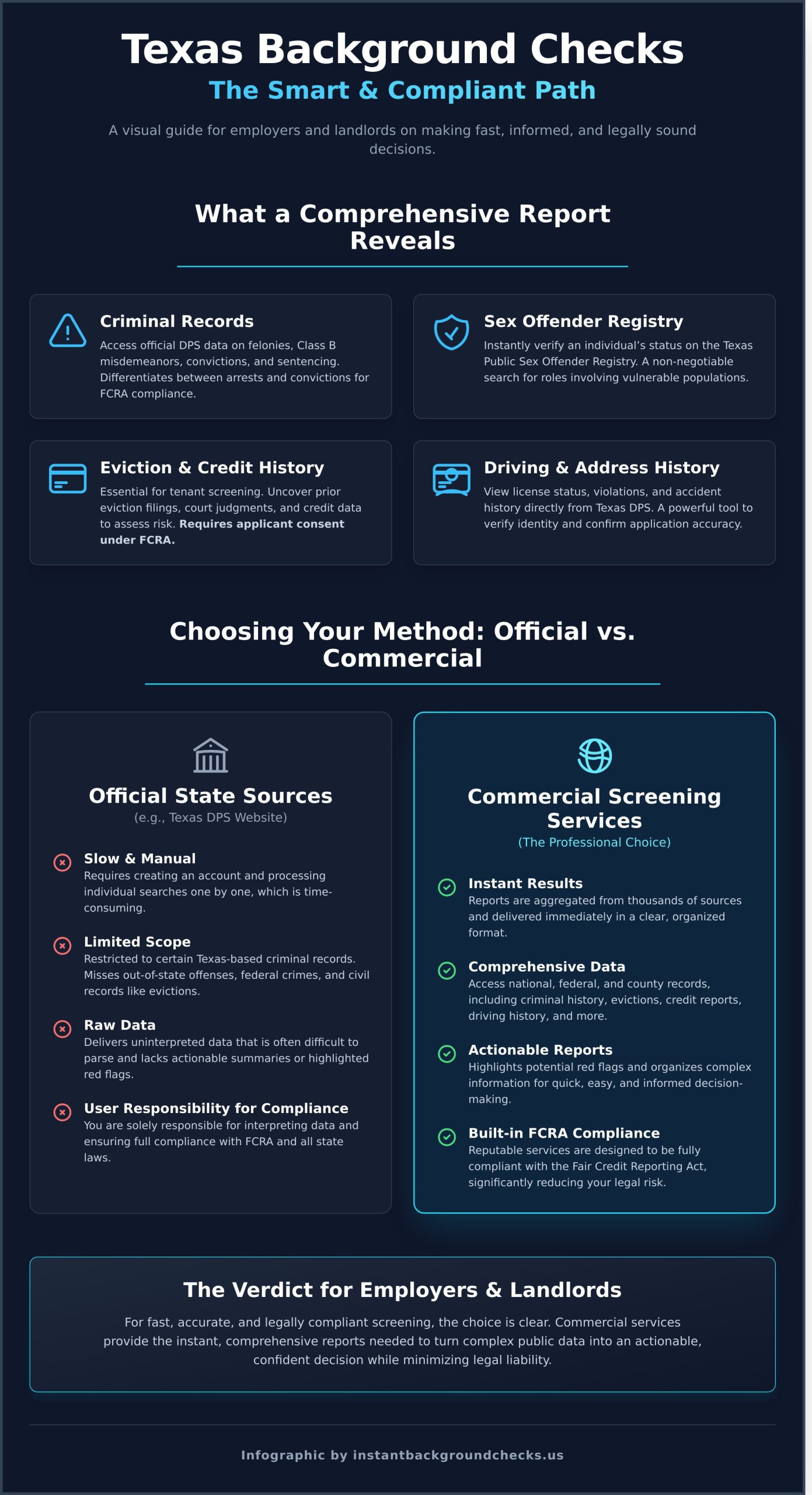
A comprehensive Texas background check provides a detailed view of an individual’s public record. Understanding the available data is the first step to making an informed, compliant decision. While the general definition of what is a background check involves verifying someone’s history, Texas public records offer specific, actionable intelligence for employers and landlords. Access the complete picture, from statewide criminal databases to county-level civil court filings, to protect your business and property.
A professional background check texas service aggregates these verified data points into a single, easy-to-read report. Here are the key components you can expect to find.
Criminal Records: Felonies, Misdemeanors & Arrests
This is the core of most employment screenings. Our reports access the official Texas Department of Public Safety (DPS) criminal history database, which includes felony and Class B misdemeanor (or greater) convictions from all 254 counties. You get verified information on offense dates, sentencing, and incarceration records. It’s crucial to distinguish between an arrest record-which is not proof of guilt-and a formal conviction. Our system clarifies this distinction for you, ensuring FCRA compliance.
Sex Offender Registry Status
This search is non-negotiable for any role involving children, the elderly, or other vulnerable populations. Our system instantly verifies an individual’s status on the Texas Public Sex Offender Registry. The report includes the subject’s name, known aliases, current address, physical description, and specific offense details. This provides a critical layer of security and due diligence for any organization.
Eviction and Credit History (For Tenant Screening)
For landlords, this data is essential for risk assessment. A tenant screening report uncovers prior eviction filings and official court judgments, revealing patterns of non-payment or property disputes. A credit history check details an applicant’s debt, payment timeliness, and public records like bankruptcies. Important: Accessing credit information requires the applicant’s explicit written consent under the Fair Credit Reporting Act (FCRA).
Driving Records and Address History
For any position requiring driving, a Motor Vehicle Record (MVR) is mandatory. This search reveals an applicant’s driver’s license status, endorsements, traffic violations, and accident history directly from the Texas DPS. Paired with a comprehensive address history report, it also serves as a powerful tool to verify identity and confirm the information provided on an application is accurate and complete.
How to Run a Background Check in Texas: Official vs. Commercial Services
When you need to run a background check in Texas, you have two primary paths: accessing state records directly or using a professional screening service. The method you choose directly impacts the speed, scope, and legal compliance of your search. For employers and landlords, understanding these differences is critical to making fast, informed, and legally sound decisions.
Method 1: The Texas DPS Public Website
The official route involves searching the state’s centralized criminal history database, which is managed by the Texas Department of Public Safety (DPS) Crime Records Division. While this is an authoritative source for statewide records, it has significant limitations for professional use.
- Slow and Manual: The process requires creating an account and paying for each individual search, which can be time-consuming for multiple candidates.
- Raw Data Only: You receive raw, uninterpreted data that can be difficult to parse. It lacks the clear, actionable summary of a professional report.
- Limited Scope: The DPS search is restricted to certain Texas-based criminal records. It will not include out-of-state offenses, federal crimes, civil records like evictions, or credit history.
Method 2: Instant Commercial Screening Services
For fast, comprehensive, and compliant results, professional screening services are the superior choice. These platforms are designed specifically for the needs of employers and landlords, providing a complete picture of an applicant instantly.
A professional service aggregates data from thousands of sources, including national, federal, and local county databases. Key benefits include:
- Instant, User-Friendly Reports: Results are delivered immediately in a clear, organized format, highlighting potential red flags.
- FCRA Compliance: Reputable services ensure their reports are fully compliant with the Fair Credit Reporting Act (FCRA) for employment and tenant screening.
- Comprehensive Data: Reports often include vital records beyond criminal history, such as eviction records, credit reports, driving history, and sex offender registry status.
The Importance of County-Level Searches
A statewide search alone is not enough. State databases can have significant reporting lags from local jurisdictions. A recent criminal case filed in Harris, Dallas, or Travis County may not appear on a state report for weeks or even months, creating a critical information gap.
A professional background check Texas service closes this gap by searching county-level court records directly. This multi-layered approach ensures you receive the most accurate and up-to-date information, protecting you from the risk of overlooking recent and relevant activity.
Texas Background Check Laws: A Compliance Guide for Employers & Landlords
Conducting a background check in Texas requires more than just accessing data; it demands strict legal compliance. Failure to follow federal and state laws can result in significant fines and lawsuits. This guide provides the critical information you need to navigate the legal landscape and protect your business or property.
FCRA: The Federal Standard
The Fair Credit Reporting Act (FCRA) is the federal law governing all background checks used for employment and tenancy decisions. It is non-negotiable. Compliance is mandatory to ensure fairness and accuracy.
- Written Consent: You must obtain clear, written permission from the applicant on a standalone document before running any report.
- Adverse Action Process: If you use information from a report to deny an applicant, you must follow a specific, multi-step notification procedure.
- Accuracy and Disputes: The law mandates that screening agencies use reasonable procedures to ensure accuracy and gives consumers the right to dispute incorrect information.
Texas State-Specific Laws
While the FCRA sets the national baseline, Texas has its own rules. Unlike some states, Texas has no statewide ‘Ban the Box’ law for private employers, which would restrict when you can ask about criminal history. However, some cities, like Austin, have such ordinances for city jobs.
Crucially, Texas law generally prohibits employers from considering arrests, detentions, or other non-conviction criminal records in hiring decisions. Performing a compliant background check texas employers can trust means filtering this data correctly. Always verify current local and state regulations, as laws can change.
The Consent and Adverse Action Process
The FCRA’s adverse action process is a strict requirement designed to protect applicants. Follow these steps precisely to remain compliant:
- Step 1: Disclose and Authorize. Provide a clear disclosure form stating you will conduct a background check. Get the applicant’s written signature.
- Step 2: Send Pre-Adverse Action Notice. Before making a final decision to deny, you must notify the applicant of your intention.
- Step 3: Provide Key Documents. This notice must include a copy of the background check report and the federal “A Summary of Your Rights Under the Fair Credit Reporting Act” document.
- Step 4: Issue Final Notice. After a reasonable waiting period (typically 5 business days) allowing the applicant to respond, you may issue the final adverse action notice.
Navigating these rules is complex. Using a professional, FCRA-compliant service is the most reliable way to get the information you need while minimizing legal risk. Get accurate, compliant results now.
Interpreting Your Texas Background Check Report
Once you receive a report, the next critical step is to understand the data. A comprehensive background check texas report contains specific legal terminology and timelines that you must interpret correctly to make fair, compliant, and informed decisions as an employer or landlord. Knowing how to identify relevant red flags while filtering out non-critical information is essential.
Focus on information directly related to the role or tenancy. For example, a history of financial fraud is a major red flag for an accounting position, while a pattern of violent offenses is more critical for a role involving public interaction or property management.
Key Terminology in Criminal Records
Not all criminal records carry the same weight. Understanding the disposition of a case is vital for accurate assessment. Key terms you will encounter include:
- Conviction: A formal judgment of guilt in a court of law. This is the most definitive and serious type of record.
- Dismissal: The court or prosecutor has dropped the charges. The case did not result in a guilty finding.
- Deferred Adjudication: A type of probation. If the individual successfully completes the terms, the case is dismissed and does not result in a final conviction.
Always note the severity of an offense by distinguishing between a felony (a serious crime) and a misdemeanor (a lesser offense).
How Far Back Do Texas Checks Go?
Reporting timelines are governed by both state law and the federal Fair Credit Reporting Act (FCRA). In Texas, the rules are clear:
- Criminal Convictions: Can be reported indefinitely, regardless of how long ago they occurred.
- Non-Conviction Records: The FCRA imposes a 7-year lookback period for arrest records and other adverse information that did not lead to a conviction.
- Financial Records: Bankruptcies can be reported for up to 10 years, while civil judgments and liens are typically limited to 7 years.
Why Choose InstantBackgroundChecks.us for Texas?
When you need fast, accurate, and compliant results, your source matters. We provide official public records data without the wait. Our service is built for professionals who require immediate, reliable information to protect their assets and maintain a safe environment.
- Get Reports in Minutes: Access comprehensive data instantly, eliminating delays in your hiring or leasing process.
- Pay Only For What You Need: Our pay-per-report model means no subscriptions, monthly minimums, or hidden fees.
- A Trusted USA-Based Service: We have been a reliable source for secure background checks since 1982.
Make your next decision with confidence. Run a secure and compliant Texas background check now.
Finalize Your Decision with a Compliant Texas Background Check
Understanding the components of a Texas background check is the first step toward making a secure and informed decision. From criminal records to employment verification, the data you access must be accurate and legally compliant. As you’ve learned, navigating state and federal laws like the FCRA is not just a recommendation-it’s a requirement for protecting yourself and your business. The right report empowers you with the clarity needed to act decisively.
Don’t leave critical decisions to chance. For a comprehensive background check texas, you need a service that is both fast and authoritative. Instant Background Checks is a trusted, USA-based service since 1982, delivering confidential and FCRA compliant reports directly to you. We eliminate the guesswork and provide verified public records with no monthly or annual fees. Get the official information you need without delay.
Ready to get the facts? Get Your Instant Texas Background Check Now.
Secure your interests and move forward with absolute confidence today.
Frequently Asked Questions
How long does a background check take in Texas?
The time to complete a background check in Texas varies. Manual searches at county courthouses can take several business days. However, modern online services provide instant access to public records. Our platform delivers comprehensive reports in minutes, not days. Get the verified information you need immediately to make fast, informed decisions. Our system constantly queries official databases for the most up-to-date results, ensuring both speed and accuracy.
How much does a background check cost in Texas?
The cost of a background check in Texas depends on the report’s depth. A basic state-level check from the Texas Department of Public Safety has a set fee. For a more comprehensive search, including national records and criminal history, costs can vary. Our service provides detailed, multi-source reports for a competitive price, giving you a complete picture without hidden fees. Access unlimited searches with a subscription for maximum value and complete information.
What shows up on a 7-year background check in Texas?
A standard 7-year background check for employment in Texas typically reveals felony and misdemeanor convictions within that timeframe. It will also show active warrants, incarceration records, and sex offender registry status. For employment screening under the Fair Credit Reporting Act (FCRA), non-conviction criminal records, like arrests that did not lead to a conviction, older than seven years are generally excluded from the report. Get a clear view of an individual’s recent history.
Are arrest records public information in Texas?
Yes, under the Texas Public Information Act, arrest records are generally considered public information. This includes details like the individual’s name, the alleged offense, and the date of the arrest. While these records are public, accessing them may require direct requests to specific law enforcement agencies. Our service simplifies this by aggregating public records from multiple official sources into one easy-to-read, confidential report. Search now for immediate access.
Can I run a background check on myself in Texas?
Yes, you can and should run a background check on yourself. This allows you to verify the accuracy of your public record and see what information employers, landlords, or other parties might find. It is a critical step to identify and correct any potential errors before they become a problem. Take control of your personal information and view your own comprehensive report securely and privately through our platform. Get the facts now.
What is the difference between a statewide and a national background check?
A statewide background check searches for criminal and public records only within Texas databases, such as those maintained by the Texas Department of Public Safety. A national background check provides a more comprehensive view by searching records across multiple states and federal databases. In today’s mobile society, a national search is critical for uncovering records an individual may have in other jurisdictions, ensuring you have a complete and accurate profile.
Do I need someone’s permission to run a background check in Texas?
This depends entirely on your purpose. For official decisions like employment, housing, or credit, federal law (the FCRA) requires you to obtain written consent from the individual. However, if you are searching public records for personal reasons, such as checking on a new acquaintance, consent is not required. Always ensure you are compliant with all applicable laws for your specific use case to avoid legal penalties.
