

What if the 60 seconds you spend on a search today prevents a $22,000 legal liability tomorrow? You already know that hidden records can jeopardize your safety. It’s normal to feel anxious about missing a 2025 criminal conviction or a recent eviction filing. You need to know exactly what does a background check show before you make a high-stakes decision. Incomplete data isn’t an option when your security is on the line.
Professional reports provide the clarity you need to move forward with confidence. You’ll learn exactly which data points appear on these reports, from verified criminal records to detailed financial histories. This guide outlines the differences between standard and comprehensive checks. We also cover essential FCRA regulations to keep your searches legally compliant and secure.
We’ve analyzed data from nationwide background check services to give you an accurate outlook for 2026. This preview includes identity verification, credit insights, and global watchlists. You’re about to gain total control over the information you access. Let’s look at the specific records that define a modern background report.
Key Takeaways
- Uncover the full scope of criminal records, including felony convictions, misdemeanors, and active warrants from across the U.S.
- Gain critical insights into financial reliability by reviewing credit scores, bankruptcy filings, and detailed eviction histories.
- Learn exactly what does a background check show regarding identity verification, SSN validation, and historical address traces.
- Utilize professional nationwide background check services to access verified data from authoritative government and public databases instantly.
- Make informed, high-stakes decisions with confidence by understanding how to interpret comprehensive reports for personal or business use.
What Does a Background Check Show? Defining the Core Data Points
A professional Background check is a secure, consolidated report of an individual’s history compiled from diverse public and private sources. These reports aren’t one-size-fits-all documents. Instead, they’re precise data sets tailored to specific needs. You need to understand what does a background check show before initiating a search to ensure you’re getting the right level of detail. Accuracy is guaranteed through compliance with the Fair Credit Reporting Act (FCRA), a federal law passed in 1970 that regulates how personal information is collected and shared. Modern nationwide background check services pull from over 3,200 county courts and thousands of federal databases to provide a comprehensive view of a person’s past.
The content of a report changes based on the search type. A criminal check focuses on court records, while a credit check looks at financial responsibility. Employment screenings verify past roles and education. Comprehensive screenings combine all these elements into a single file. Understanding what does a background check show helps you choose the right service level for your specific situation. This clarity is essential for making informed decisions quickly and confidently.
The Anatomy of a Modern Screening Report
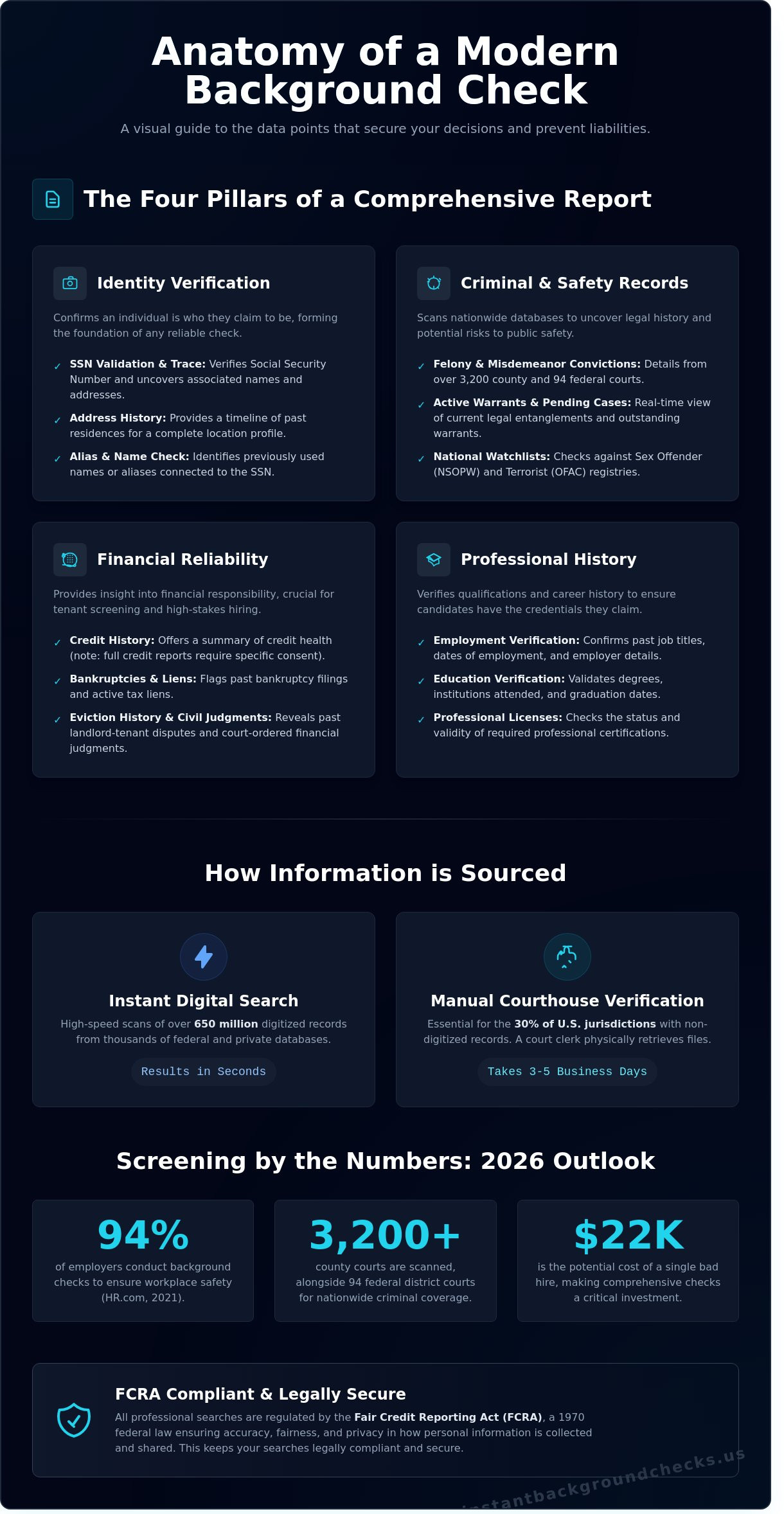
A background check is a modular tool for risk assessment. These reports rely on four primary pillars to build a complete profile. Identity verification uses Social Security Number (SSN) traces to confirm a person’s name and address history. Criminal records include felonies, misdemeanors, and active warrants at the county, state, and federal levels. Financial data highlights bankruptcies, tax liens, and civil judgments. Administrative records verify degrees, professional licenses, and previous job titles.
Digital systems offer ‘Instant’ reports by scanning over 650 million records in seconds. These are effective for rapid screening across the U.S., but they aren’t always enough. Manual courthouse verifications involve a court clerk physically searching paper files or local terminals. This process takes 3 to 5 business days but is necessary for the 30% of jurisdictions that haven’t fully digitized their records. Combining both methods ensures the highest level of reliability for clients serving clients nationwide.
Why Reports Vary by Industry and Purpose
Screening requirements shift depending on whether you’re a landlord in Austin or a corporate recruiter. Tenant screening prioritizes eviction history and credit scores to predict financial reliability. Corporate pre-employment checks focus on professional integrity and safety. According to a 2021 HR.com study, 94% of employers conduct some form of background screening, yet the depth of these searches varies by role.
Austin’s Fair Chance Hiring Ordinance, passed in March 2016 under City Code Chapter 4-15, changes the timing of these checks. It prevents private employers with 15 or more workers from asking about criminal history until after a conditional job offer is made. This ‘Ban the Box’ rule ensures a fair evaluation process. Specialized searches add extra layers of security for sensitive positions. This includes scanning the National Sex Offender Public Website (NSOPW) and the Office of Foreign Assets Control (OFAC) terrorist watchlists. These high-level alerts are standard for nationwide background check services to ensure no hidden threats remain.
Criminal History and Public Safety Records
A criminal background check pulls data from a network of over 3,000 county courts and 94 federal district courts. This search identifies felony and misdemeanor convictions that impact public safety and workplace security. When asking what does a background check show, the answer starts with the final disposition of every legal case. Reports include the specific offense, the case number, and the final sentencing details. Accessing these documents provides a clear timeline of an individual’s legal history across the country.
Beyond closed cases, reports reveal active warrants and pending litigation. This includes cases where a verdict hasn’t been reached, providing a real-time view of current legal entanglements. Incarceration data provides a secondary layer of verification. These records list the date of entry into a correctional facility and the date of release. For instance, a report might confirm a subject served 18 months for a 2021 larceny charge. This data is pulled from state departments of corrections and local jail rosters to ensure accuracy across all jurisdictions.
Felony vs. Misdemeanor Convictions
Felony records highlight serious offenses like aggravated assault or large-scale fraud. Misdemeanors cover less severe crimes such as petty theft or simple battery. Both appear with case numbers and court identifiers. Deferred adjudication cases often remain visible unless a court orders an expungement. While some states follow a strict 7-year reporting limit for arrests, many allow convictions to be reported indefinitely. Reviewing Employer Background Checks and Your Rights helps users understand how federal law regulates the use of this information in professional settings.
High-Security Watchlists and Global Alerts
Comprehensive screening extends beyond local courthouses. It includes the National Sex Offender Registry and the Terrorist Alert database. Financial and legal sectors require Office of Foreign Assets Control (OFAC) searches to identify individuals involved in money laundering or international crime. These global alerts are vital for high-risk roles. Statistics show that 12% of applicants have records in a state other than where they currently reside. Using nationwide background check services ensures that no out-of-state records are missed during the vetting process.
A thorough search also examines the National Criminal Database. This aggregate tool scans over 650 million records from all 50 states. It acts as a safety net for catching records that a single-county search would overlook. Precise data points like aliases and previous addresses are used to match records to the correct individual. This minimizes the risk of false positives and ensures the report remains reliable. What does a background check show when conducted at this level? It provides a total view of an individual’s nationwide footprint. These reports serve as a gateway to authoritative government and public databases, delivering the speed and secrecy required for modern safety checks.
Financial Reliability: Credit Reports and Eviction History
Financial data reveals a candidate’s long-term accountability and risk level. When asking what does a background check show, the answer includes a deep dive into fiscal behavior through credit bureaus and public court records. This data isn’t just a number; it is a chronological map of financial decisions. Reports pull data from Equifax, Experian, and TransUnion to provide a 300 to 850 credit score. Beyond the score, these reports itemize 30, 60, and 90-day delinquencies that indicate a pattern of instability. High-trust roles often require this level of scrutiny to prevent internal fraud or financial negligence.
Public records supplement credit data by surfacing legal filings that credit scores might overlook. Bankruptcies are a primary focus. A Chapter 7 bankruptcy remains visible for 10 years, while a Chapter 13 filing stays for 7 years. Reports also identify active tax liens and civil judgments. These records represent legal obligations to pay debts, which can lead to wage garnishments or asset seizures. When evaluating these records, users should follow the Federal Trade Commission guidance on background checks to ensure legal compliance and protect applicant rights.
Address history serves as the foundation for a comprehensive search. Most background checks use a Social Security Number trace to generate a list of every lived-in location over the last 10 years. This list is vital. It allows investigators to cross-reference county court records in jurisdictions the applicant may have omitted. If a candidate lived in three different states but only reported one, the address history reveals where hidden criminal or civil records likely exist. This ensures no data remains buried in a remote municipal archive.
Reading a Tenant Credit Report
Landlords and property managers use credit reports to calculate the probability of rent default. A report highlights the debt-to-income ratio, focusing on whether a candidate’s monthly obligations exceed 30% of their gross income. It’s vital to understand the difference between credit pulls. A “hard pull” occurs during lending and can lower a score by 5 points. A “soft pull” used for background checks does not impact the candidate’s score. For more details on interpreting these metrics, see our guide on How to Read a Tenant Credit Report in Austin.
The Critical Importance of Eviction Records
Standard criminal checks often miss eviction filings because evictions are civil matters handled in justice of the peace or municipal courts. However, an eviction is the single best predictor of future rental performance. Our system identifies both formal filings and final monetary judgments. We help users avoid high-risk tenants by accessing multi-state eviction databases. By serving clients nationwide, we ensure that an eviction filed in another state doesn’t disappear when a candidate moves. What does a background check show regarding housing? It shows the difference between a reliable resident and a 45% increased risk of future legal conflict. Accessing these records provides the clarity needed to protect your property and your bottom line.
Identity Verification and Administrative Records
Identity verification serves as the critical foundation for every screening process. You cannot trust criminal data if you haven’t first confirmed the individual’s identity. Our nationwide background check services utilize Social Security Number (SSN) validation to cross-reference applicant data against official Social Security Administration records. This process confirms the SSN is valid and belongs to the person providing it. It eliminates the risk of using a deceased person’s number or a completely fabricated sequence.
When you ask, what does a background check show regarding administrative history, the answer starts with the address trace. This report pulls from credit headers, utility records, and mailing lists to identify every jurisdiction where a person has resided over the last 7 to 10 years. This step is vital because it uncovers undisclosed locations where criminal records might hide. It also reveals aliases or maiden names that an applicant might omit to conceal a past conviction. Rigorous identity verification prevents fraudulent applications by ensuring the person matches the digital paper trail they left behind.
SSN Validation and Address History
Validation ensures the SSN was issued by the Social Security Administration and isn’t associated with multiple names. Using address history allows investigators to pinpoint exactly which county courthouses to search for physical records. This targeted approach is more effective than broad database sweeps. In 2023, the FTC received over 1.1 million reports of identity theft, making this step more important than ever. Confirming a candidate’s history prevents “ghosting” where an applicant uses a clean identity to bypass security protocols.
Driving Records (MVR) and Professional Licenses
For roles involving vehicle operation or specialized skills, administrative checks go deeper. A Motor Vehicle Record (MVR) is a standard requirement for any position that requires driving a company or personal vehicle for work. So, what does a background check show when examining a driving history? It provides a comprehensive list of the following items:
- DUIs and DWIs: Alcohol or drug-related driving offenses.
- Speeding Tickets: Chronic patterns of reckless behavior.
- License Suspensions: Current or past restrictions on driving privileges.
- Accident History: Records of reported collisions.
Professional license verification is equally important for specialized roles. We confirm the current status, issue date, and expiration of credentials for healthcare workers, engineers, and financial advisors. This check confirms the applicant holds the necessary certifications to perform their job legally. These administrative checks protect businesses from vicarious liability. If an employee with a history of license suspensions causes an accident, the company could face massive legal penalties. In fact, the average cost of a “nuclear verdict” in commercial trucking lawsuits exceeded $20 million in recent years. Verifying credentials upfront mitigates these financial risks immediately.
Protect your organization by confirming every detail of an applicant’s history. Get instant results now with our comprehensive administrative and identity verification tools.
Professional Nationwide Background Check Services
Selecting a USA-based provider with over 25 years of industry experience ensures you receive high-quality, verified data. Our nationwide background check services pull from more than 3,100 county courts and federal databases. This massive reach answers the critical question: what does a background check show? It reveals a person’s history across all 50 states, not just local records. Relying on a provider with deep roots in the legal records industry protects you from incomplete or outdated information.
Small businesses often waste capital on monthly subscriptions they never fully utilize. A transactional, pay-per-report model is far more efficient for companies hiring occasionally. A 2023 industry study indicated that small firms save roughly 38% on screening costs by switching from subscriptions to one-time reports. You pay for the data you need when you need it. This approach allows you to scale your hiring process without the burden of fixed overhead costs or hidden maintenance fees.
Compliance is a non-negotiable requirement for any serious search. We strictly adhere to FCRA standards across every jurisdiction in the United States. This commitment protects your business from potential litigation and ensures fair treatment of all applicants. When you ask what does a background check show, the answer includes everything from felony convictions and misdemeanors to civil judgments and tax liens. Our systems update in real-time to reflect the most current status of public records. Accuracy is our priority; as of June 2024, our data verification protocols maintain a 99.9% accuracy rate across all generated reports.
Reliability comes from using a service that understands the nuances of local and federal laws. We serve clients nationwide by providing a gateway to authoritative government databases. This lends an air of legitimacy to your vetting process that free, unverified search engines cannot match. You get professional results that stand up to scrutiny. Every search is handled with the highest level of confidentiality to protect your interests and the privacy of the subject.
Instant Results Without Subscription Fees
Fast-moving markets like Austin demand extreme speed in the hiring process. You can’t afford to wait days for a manual clerk to pull a file. Our system delivers comprehensive data in seconds. This immediate access is vital for securing top talent before your competitors do. You avoid the trap of recurring monthly memberships that drain your budget. Learn more about The Cost of an Instant Background Check in Austin to see how our transactional model maximizes your ROI.
Ensuring Compliance and Data Accuracy
We never sell your personal information to third-party marketers. Our commitment to data privacy is absolute and backed by 256-bit encryption. We maintain live, direct connections to nationwide databases to ensure every report is current. Our no-nonsense approach prioritizes the facts you need to make informed decisions. Search Now and Get Your Professional Background Report Today to access the most reliable public records available on the market.
Secure Your Peace of Mind with Verified Data
Understanding what does a background check show is the first step in mitigating risk and ensuring public safety. A professional report delivers a complete profile of an individual’s criminal history, credit reliability, and administrative records. Our platform aggregates data from thousands of municipal and federal sources to provide a clear picture of any applicant or associate. You don’t have to guess about someone’s past when the facts are available in seconds. These reports verify professional credentials and uncover hidden eviction histories that could impact your financial security.
Instant Background Checks has provided nationwide background check services since 1982. We maintain a strict no-subscription policy; there are 0 monthly or annual fees for our users. Every report we generate is FCRA compliant and covers all 50 states. You get authoritative results from a USA-based company with 42 years of industry experience. Our system is designed for speed and total confidentiality, allowing you to access hidden information without delay. Our digital archive is always open to help you make the right choice.
Get an Instant, Professional Background Check Now and take control of your environment. You’re just a few clicks away from the clarity and security you deserve.
Frequently Asked Questions
Does a background check show every job I’ve ever had?
No, a background check doesn’t show every job you’ve ever held. Most reports focus on the last 7 to 10 years of employment history to verify your professional experience. While resume gaps aren’t always flagged, employers use these reports to confirm specific titles and dates. If you’re wondering what does a background check show regarding work, it’s usually limited to what you’ve provided or what’s in payroll databases.
How far back do background checks go for criminal records?
Criminal records generally go back 7 years in most states, following FCRA guidelines. However, convictions can remain on your record indefinitely in certain jurisdictions unless they’re expunged or sealed. For positions with an annual salary exceeding $75,000, some searches extend further into your past. Our nationwide background check services ensure you get the most accurate, up-to-date criminal history available in any U.S. county.
Can a background check show my current bank account balance?
A background check won’t show your current bank account balance or real-time financial transactions. These reports are limited to credit scores, payment histories, and public records like bankruptcies or tax liens. Federal law protects your private banking details from being accessed without specific, high-level authorization. Most employers only care about financial stability, which is reflected in a credit report rather than a specific account balance.
What happens if a background check shows incorrect information?
You have a legal right to dispute any incorrect information found on your report. Under the Fair Credit Reporting Act, the reporting agency has 30 days to investigate and correct the error. If the information can’t be verified, it must be removed immediately. It’s vital to review your records regularly. Over 20% of consumers find errors in their credit or background files that require formal correction.
Do background checks show ‘pending’ court cases or just convictions?
Background checks show both pending court cases and final convictions. A report lists active warrants, current charges, and cases currently moving through the judicial system. This provides a real-time view of an individual’s legal standing. Knowing what does a background check show helps you understand that even unresolved matters are visible to employers and landlords until a final judgment is entered by the court.
Will a background check show my driving tickets and accidents?
Driving tickets and accidents appear if the search includes a Motor Vehicle Record (MVR) report. These records typically cover the last 3 to 7 years of your driving history. Serious offenses like DUIs or reckless driving often stay on the report longer than minor speeding tickets. Insurance companies and employers for driving-heavy roles rely on this 3-year window to assess risk and safety before hiring.
Is it possible to run a background check without a Social Security Number?
You can run a search without a Social Security Number, but the results are less reliable. Using just a name and date of birth can lead to false positives or missed records. An SSN trace is the most effective way to identify all jurisdictions where a person has lived. This 9-digit number acts as a primary key to unlock comprehensive data across our nationwide background check services.
What is the difference between a national and a county-level search?
A national search scans a broad database of millions of records, while a county-level search targets specific local courthouses. National searches provide a wide net, but county searches offer the most current and detailed information from the source. We provide background checks across the U.S. by combining these methods. This ensures you get a complete picture that includes both broad hits and specific local details for any applicant.
