

What if a single minor violation from 2023 is currently inflating your insurance premiums or stalling a job application? You understand that your past behind the wheel carries weight, but the confusion surrounding different record types often leads to unnecessary anxiety. Most drivers worry about old tickets resurfacing or how specific points impact their legal standing. You deserve clarity and immediate access to your verified public records.
This 2026 guide clarifies exactly what does a driving record history show in Texas, from active license status to specific traffic convictions and accident involvements. You’ll learn about the standard three year and five year look-back periods that govern these official documents. We also provide a direct path to secure these details through nationwide background check services. Stop guessing about your data. This breakdown ensures you understand every line item on a Texas MVR and explains how to obtain a comprehensive report across the U.S. instantly.
Key Takeaways
- Identify the six distinct types of Texas driver records to select the specific version that meets your information requirements.
- Learn exactly what does a driving record history show in Texas, including verified data on traffic violations, accidents, and license status.
- Understand how the current Texas point system tracks driver behavior and affects eligibility for those serving clients nationwide.
- Secure accurate results by leveraging nationwide background check services that look beyond state lines to provide a comprehensive history across the U.S.
- Maintain strict legal compliance with DPPA and FCRA regulations when accessing sensitive public records and driving data.
Understanding the Six Types of Texas Driver Records
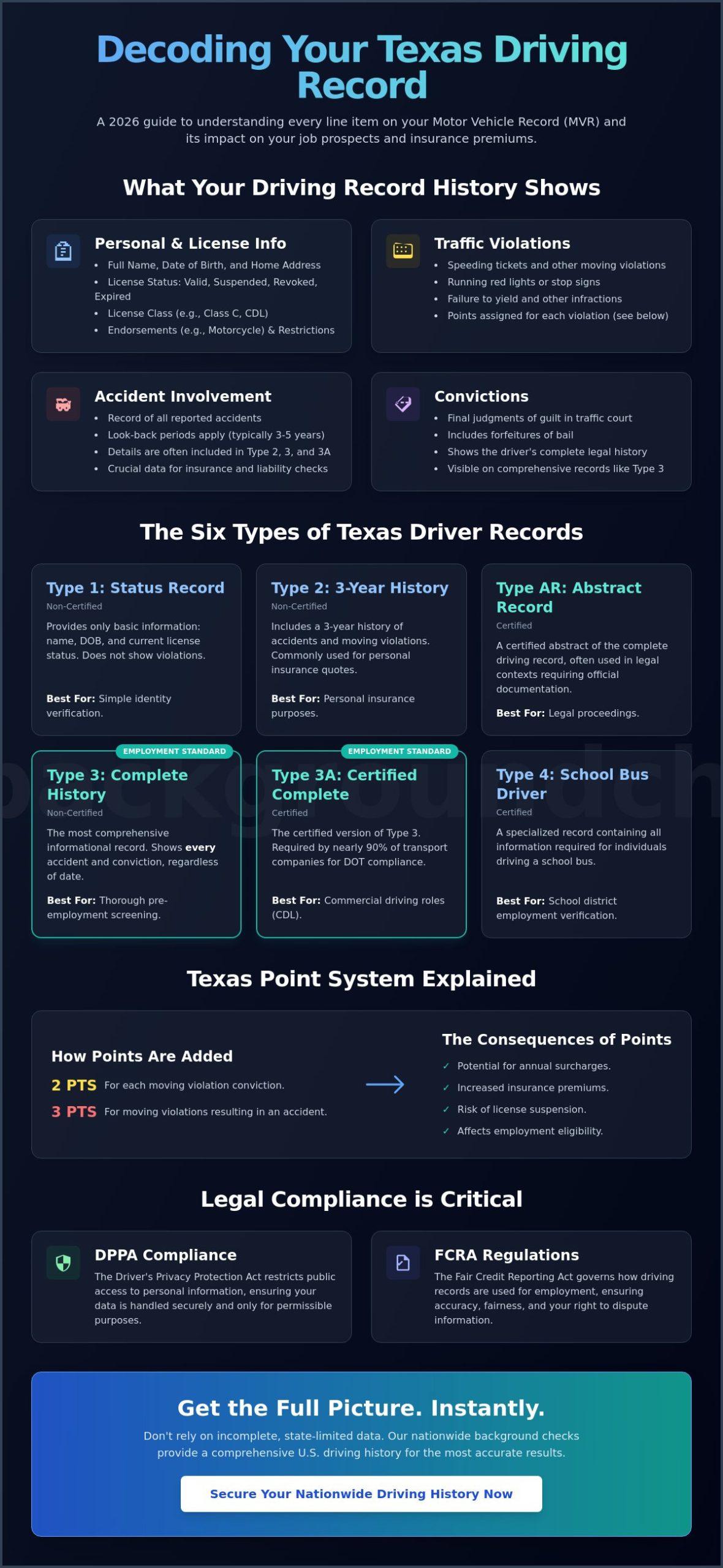
The Texas Motor Vehicle Record (MVR) is the official history maintained by the Texas Department of Public Safety (DPS). It tracks every interaction a driver has with state traffic laws. When you ask what does a driving record history show in Texas, the answer depends on the specific type of record you pull. Texas offers six distinct versions of driver records. Each serves a different purpose, ranging from simple identity verification to intensive legal scrutiny. Selecting the correct version is vital for accuracy.
For most pre-employment screening services, a Type 3 or 3A record is the industry standard. Using an insufficient record type can leave a business vulnerable to liability. You must also distinguish between certified and non-certified records. Non-certified records are for informational use. Certified records are official documents with a state seal, often required for legal proceedings or government compliance. Our nationwide background check services ensure you get the exact documentation required for your specific industry.
Type 1 and Type 2: The Basics
Type 1 records are the most limited. They provide basic status information including name, date of birth, and current license status. This version doesn’t list any specific violations. Type 2 records provide more detail by including a 3-year history of accidents and moving violations. While Type 2 is common for personal insurance quotes, it’s rarely sufficient for a comprehensive background check Texas employers require. It omits long-term patterns and demerit points that occurred more than 36 months ago. Relying on a 3-year window can hide significant safety risks from an employer’s view.
Type 3 and 3A: The Employment Standard
Type 3 records provide a complete driving history. This includes every accident and conviction on the driver’s record, regardless of how long ago it happened. Type 3A is the certified version of this complete history. It’s the most requested record for commercial driving positions because it includes the driver’s date of birth for identity confirmation. Understanding what does a driving record history show in Texas becomes clear when you look at a 3A report; it’s a total snapshot of professional reliability. In 2024, state data indicated that nearly 90% of transportation companies required a Type 3A for all new hires to maintain DOT compliance. It offers the highest level of security for businesses serving clients nationwide.
Other specialized records include the Type AR, which is a certified abstract of the complete record, and Type 4, which is specifically for school bus drivers. Choosing the right tool is essential. If you’re hiring for a position that involves operating a vehicle, don’t settle for basic status checks. Get the full history to protect your staff and your assets. Professional investigators use these records to build a clear picture of an individual’s responsibility behind the wheel. Use our platform to access these records instantly and securely.
Decoding the Data: What Exactly Shows on the Report?
Your driving record history is far more than a simple list of speeding tickets. It serves as a comprehensive legal ledger of your behavior and status behind the wheel. Every piece of data is pulled directly from the Texas Department of Public Safety (DPS) database to ensure accuracy. For the purposes of MVR reporting, a conviction is a final judgment of guilt or a forfeiture of bail and collateral deposited to secure a person’s appearance in court. While the raw government files are often dense, nationwide background check services provide these details in an easy-to-read format. Understanding what does a driving record history show in Texas is the first step in managing your professional reputation or personal safety.
Personal Identification and License Status
The report begins with your current standing. It verifies if your license is Valid, Suspended, Revoked, or Expired. It specifies your license class, whether you hold a standard Class C for passenger vehicles or a specialized CDL for commercial work. Any endorsements, such as those for motorcycles, or restrictions, like the requirement for corrective lenses, are clearly labeled. The record also archives your current home address and any previous addresses associated with the license over the last several years. This ensures that the identity on the report matches the individual being screened.
Traffic Violations and Criminal Convictions
Moving violations form the core of the report. This includes speeding, running red lights, and failure to yield. Serious criminal offenses are also documented. DUI/DWI convictions, reckless driving, and vehicular manslaughter are permanent marks that impact insurance rates and employment. Texas tracks these through the Texas Point System, where points are assigned based on the severity of the offense. Don’t assume an out-of-state ticket won’t show up. Most states report convictions back to the Texas DPS, ensuring your record follows you across state lines.
Accident History and Financial Responsibility
Texas records every accident where a peace officer submitted a formal crash report. These entries include the date of the crash and the severity of the incident. Beyond the driving itself, the report tracks your financial reliability. It lists SR-22 requirements and any other proof of financial responsibility filings required by the state. If you were involved in a breathalyzer refusal, the report will show an Administrative License Revocation (ALR). Accessing nationwide background check services allows you to verify this data instantly. This level of transparency helps you address errors before they affect your life.
The Texas Point System and Its Impact on Records
Texas officially repealed the Driver Responsibility Program surcharges on September 1, 2019. This legislative change stopped the collection of expensive annual fees, but the point system itself stayed active. The Department of Public Safety (DPS) continues to monitor these points to identify drivers who pose a consistent threat to public safety. If you are wondering what does a driving record history show in Texas, the point count is a primary indicator of driver reliability and risk.
Points remain on a Texas record for exactly three years from the date of conviction. This 36-month window is a standard used by insurance providers to determine premium rates and coverage eligibility. Access to this sensitive data is protected under DPPA and FCRA Regulations. These federal statutes limit who can view motor vehicle records and for what purpose. Our nationwide background check services ensure that every report we generate meets these rigorous legal standards while serving clients nationwide.
How Points Accumulate
The point system is straightforward and transparent. A standard moving violation conviction, whether it occurs in Texas or out-of-state, adds 2 points to the record. If the moving violation resulted in a traffic crash, the penalty increases to 3 points. Most non-moving violations don’t result in points. This includes equipment failures, expired registrations, or administrative lapses. By focusing on moving violations, the state isolates behavioral risks from technical ones. Our background checks across the U.S. allow employers to see these distinctions clearly during the hiring process.
Consequences of Excessive Points
The DPS monitors these totals closely to maintain road safety. A driver faces an automatic license suspension if they accumulate 6 points within a 12-month period. The limit for a 24-month period is 9 points. These thresholds are firm and lead to immediate administrative action. Understanding what does a driving record history show in Texas is essential for any business owner hiring drivers, as points directly correlate to overhead costs.
For businesses, these points are a major liability. A driver with a high point total can increase commercial insurance premiums by 20% to 45% annually. Employers use our verified data to vet applicants before they get behind the wheel of a company vehicle. These records are also relevant in tenant screening processes. Many landlords view a history of reckless behavior or multiple license suspensions as a sign of general instability. Accessing this information instantly allows decision-makers to mitigate risk before it becomes a legal or financial burden.
Legal Compliance: DPPA and FCRA Regulations
Accessing a motor vehicle record involves navigating strict federal and state laws. Privacy remains the primary focus for professional background check providers. You must have a recognized “permissible purpose” to legally run a check on another person. Many free websites ignore these privacy standards. They often provide inaccurate data while violating federal statutes. This exposes users to potential legal action. We provide nationwide background check services that prioritize legal integrity and speed. Our platform ensures that every search aligns with current regulatory frameworks.
The Driver Privacy Protection Act (DPPA)
The DPPA is a 1994 federal law that restricts the release of personal information from state motor vehicle departments. It protects sensitive data like social security numbers, photographs, and home addresses. However, the law provides specific exceptions for data access. These include insurance company risk rating and underwriting, government agency functions, and employment verification for commercial driving roles. As a USA-based company serving clients nationwide, we strictly follow DPPA guidelines. We ensure that what does a driving record history show in Texas is accessed only by those with a legitimate legal right to see it. This protects both the searcher and the subject of the report.
FCRA Requirements for Employers and Landlords
The Fair Credit Reporting Act (FCRA) regulates how businesses use consumer data for hiring or housing decisions. If you use a driving record to evaluate a candidate, you must follow federal law. First, you must obtain clear, written consent from the individual before running the report. You cannot legally process the search without their signed permission. If the driving record leads to a rejection, you must follow the mandatory Adverse Action process. This involves providing the candidate with a copy of the report and a summary of their rights under the FCRA. In 2023, FCRA-related litigation reached record highs, with over 5,200 cases filed in federal courts. Don’t risk your business by using unverified or non-compliant sources. Knowing what does a driving record history show in Texas is only useful if you acquire the information through legal, verified channels.
Secure your business and personal interests with verified data. Access compliant records now.
How to Secure an Accurate Driving History Nationwide
A single-state search leaves dangerous gaps in your investigation. If an individual lived in another state within the last five years, a Texas-only inquiry will miss their entire history in those jurisdictions. You need a complete picture to ensure safety and compliance. Understanding what does a driving record history show in Texas is the first step, but it shouldn’t be your last. Our nationwide background check services bridge these gaps by pulling data from every jurisdiction in the country. We offer immediate access to public records across the U.S., ensuring you don’t rely on incomplete data.
Our platform operates on a transactional model. You won’t deal with monthly fees or hidden subscription costs. You pay for the reports you need when you need them. This direct approach prioritizes your time and budget while providing verified data from authoritative sources.
Why Cross-State Searches Matter
Drivers frequently hold licenses in multiple states over a 10-year period. Statistics indicate that approximately 12% of the U.S. population moves between states annually. National databases often catch violations that haven’t been reported back to the home state yet. Our system validates Social Security numbers to identify hidden addresses and previous residences. This process ensures you aren’t blindsided by a clean local record that masks a history of DUI or reckless driving in another state. We provide verified data from across the U.S. to ensure no critical incident stays hidden. When you ask what does a driving record history show in Texas, remember that the answer is only partial without a nationwide sweep.
- SSN Validation: We trace address history to find where records actually exist.
- Multi-Jurisdictional Data: Access records from over 3,000 counties and all 50 states.
- Hidden Violations: Catch out-of-state citations that haven’t hit the local DMV yet.
Instant Results with Instant Background Checks
Skip the government wait times and complex manual forms. Traditional state requests can take 7 to 10 business days to process. Instant Background Checks provides a high-performance utility that delivers results in seconds. Our reports are comprehensive. They include criminal history, credit data, and driving records in a single, easy-to-read format. We act as your discreet, no-nonsense partner in information gathering. Our system is always available and completely private. Search now to get the verified data you need for informed decision-making. Don’t wait for slow bureaucratic processes when you can access authoritative public records immediately.
Take Control of Your Driving History Now
Understanding what does a driving record history show in Texas is essential for maintaining your legal standing and insurance rates. Texas maintains six specific versions of driver records that track everything from basic status to a comprehensive 15-year history. These reports detail accidents, traffic points, and license suspensions that can impact your career and financial security. If you need to leverage your vehicle’s equity for financial flexibility, you can explore Car Title Loans through V8Loans as a secured borrowing option.
Instant Background Checks has provided nationwide background check services since 1982. We deliver verified public records from across the U.S. with total transparency. You’ll find no hidden monthly or annual fees here. You only pay for the specific reports you need when you need them. Our system ensures strict FCRA and DPPA compliance for every search, giving you the same high-performance tools used by private investigators. Secure the hidden information you need to protect your peace of mind immediately.
Search Now for Instant Nationwide Driving Records
Your driving history shouldn’t be a mystery. Get the facts today and stay ahead of the curve.
Frequently Asked Questions
How far back does a Texas driving record go?
A standard Texas Type 2 driver record covers the previous 3 years of your history. If you need a more extensive look, a Type 3 or 3A certified record provides a complete history since your license was first issued. Insurance companies typically focus on the most recent 36 months to calculate your premiums. You can access these public records through our nationwide background check services to verify your data quickly.
Can I see my own Texas driving record online instantly?
You can access your Texas driving record online immediately through the Texas Department of Public Safety website or a verified third-party provider. Most digital portals deliver a PDF copy within seconds of a successful search. It’s vital to check what does a driving record history show in Texas before an employer runs their own report. Our platform provides similar speed for background checks across the U.S.
Do dismissed tickets show up on a Texas MVR?
Dismissed tickets don’t usually appear on a standard Texas Motor Vehicle Record once the court processes the paperwork. If you successfully complete a defensive driving course or a deferred adjudication period, the violation is typically hidden from the public view. However, the original citation might still appear in broader criminal database searches until it’s officially expunged. We help users track these details through comprehensive nationwide background check services.
How long do accidents stay on my Texas driving record?
Accidents remain on a Texas driving record for at least 3 years from the date of the crash. Major incidents involving fatalities or serious injuries may stay visible for 5 years or longer on specific certified reports. Insurance providers generally prioritize the last 3 years of data when evaluating your risk profile. Use our tools to monitor your driving history and ensure your information is accurate across all 50 states.
Is a DUI a criminal record or a driving record in Texas?
A DUI in Texas appears on both your driving record and your criminal record. It’s classified as a Class B misdemeanor for a first offense, creating a permanent entry in the Texas Crime Information Center database. Simultaneously, the conviction or related license suspension stays on your driver record for at least 10 years. Our nationwide background check services verify both sets of data to provide a complete picture of an individual’s history.
Can an employer in Texas fire me for a bad driving record?
Texas is an at-will employment state, so an employer can legally fire you for a poor driving record at any time. This is common for roles involving company vehicles or delivery tasks where insurance liability is a primary concern. Employers use these records to mitigate risk and maintain safety standards. Knowing what does a driving record history show in Texas helps you prepare for these professional evaluations and protect your career.
What is the difference between a certified and non-certified driver record?
A certified record (Type 3A) is an official document signed by the state and is required for court proceedings or employment verification. A non-certified record (Type 2) is a basic summary used for personal information or insurance quotes. Certified copies are often mandatory for commercial driver license holders. We provide verified data access for users serving clients nationwide who need reliable and authoritative documentation for any purpose.
How do I remove points from my Texas driving record?
Texas officially repealed its Driver Responsibility Program and the associated point system on September 1, 2019. You no longer need to remove points, but you can still prevent convictions from appearing by completing a state-approved defensive driving course once every 12 months. Dismissing a ticket this way keeps your record clean and your insurance rates stable. Use our search tools to verify that your record reflects these updates accurately.
