

A single error in your denial process can trigger $1,000 in statutory damages plus attorney fees under federal law. Many property owners feel overwhelmed when trying to determine what is adverse action for tenant screening Texas while simultaneously following strict FCRA mandates. You know that high-quality vetting is vital for your property’s safety, yet the threat of a lawsuit from a rejected applicant often creates unnecessary hesitation. Managing complex legal codes shouldn’t stop you from filling vacancies quickly.
Our 2026 guide provides the clarity you need to handle every denial with professional precision. You’ll learn to master Texas-specific requirements while leveraging nationwide background check services to maintain a consistent, legal standard across all your holdings. We’ll outline the exact steps for delivering compliant notices and securing your documentation against future claims. This overview details the mandatory timelines and the specific language required to keep your business protected and efficient.
Key Takeaways
- Master the legal intersection between the Fair Credit Reporting Act and the Texas Property Code to protect your rental business from liability.
- Define exactly what is adverse action for tenant screening Texas and recognize why actions like requiring a higher security deposit trigger mandatory federal disclosures.
- Discover the essential elements of a compliant adverse action notice, including the specific consumer reporting agency data points required to maintain legal transparency.
- Leverage nationwide background check services to automate compliance and access verified public records across the U.S. instantly.
- Follow a professional step-by-step checklist to establish clear selection criteria and secure your property with authoritative, confidential data.
Understanding Adverse Action Under FCRA and Texas Law
Landlords operating in 2026 must maintain strict compliance with federal and state regulations to mitigate legal risks. Adverse action occurs whenever a landlord makes a decision that negatively affects a rental applicant based on information found in a consumer report. These reports are comprehensive. They include verified criminal records, eviction history, and credit data sourced from a Consumer Reporting Agency (CRA). While the Fair Credit Reporting Act (FCRA) sets the national standard, local regulations often add layers of responsibility. Professional property managers serving clients nationwide must master these intersections to protect their portfolios.
Understanding what is adverse action for tenant screening Texas landlords face requires looking at both federal mandates and specific state codes. Federal law ensures that applicants have a right to know why they were denied or why their lease terms were altered. This transparency protects consumer privacy and ensures data accuracy across the U.S. If your screening process identifies a risk, you must follow a specific sequence of notifications to remain within the law.
The Legal Definition of Adverse Action
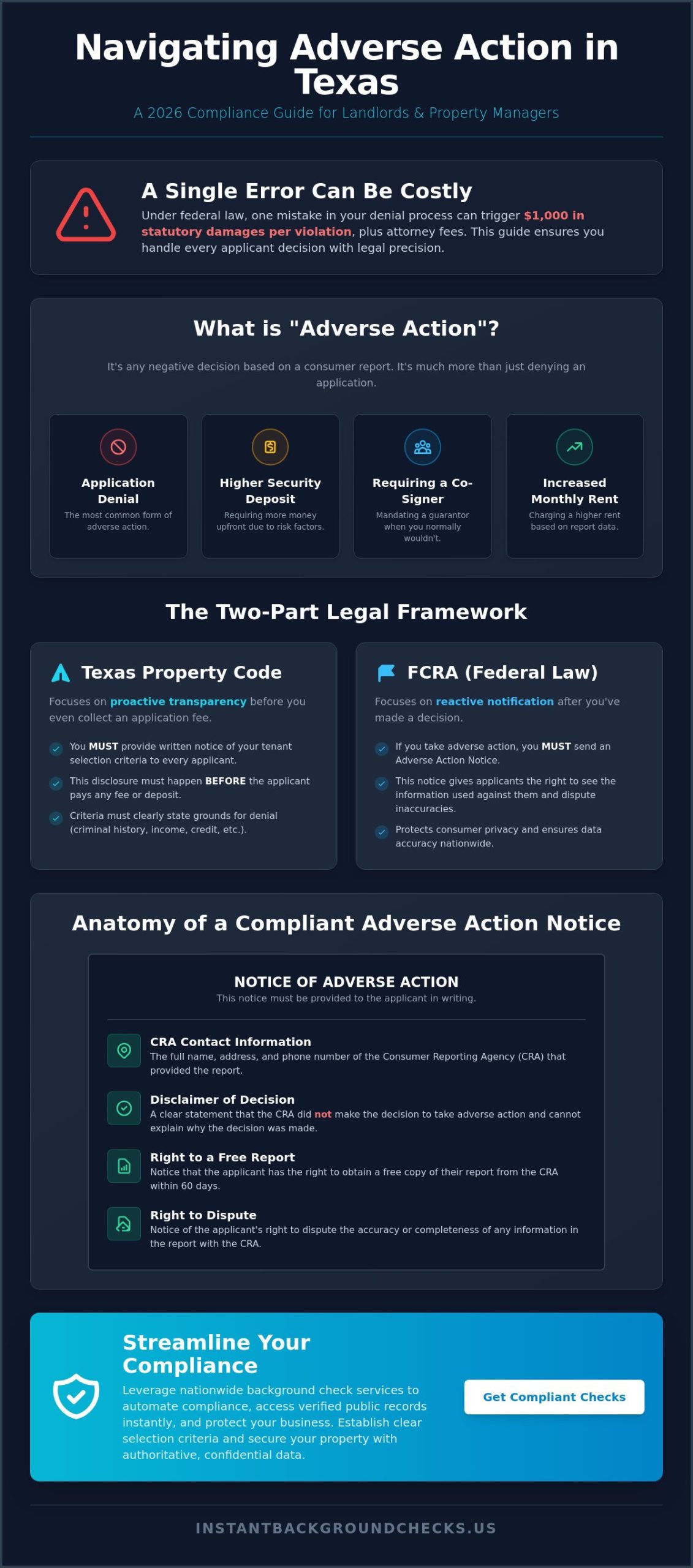
Adverse action is not limited to a flat-out rejection of a rental application. It includes any decision that places a higher burden on the applicant than your standard criteria. For example, requiring a higher security deposit, demanding a co-signer, or increasing the monthly rent based on a credit report all constitute adverse action. The CRA provides the raw data, but the landlord is responsible for the final decision and the subsequent notification. Adverse action is any move that negatively impacts a tenant’s potential lease terms based on consumer report data.
Texas-Specific Disclosure Requirements
Texas law supplements federal requirements with specific mandates regarding transparency. Under Texas Property Code Section 92.3515, landlords must provide written notice of their tenant selection criteria to every applicant. This disclosure must happen before the applicant pays an application fee. This rule has been a critical component of state law since its 2021 updates. The notice must clearly state the grounds for which an application may be denied, such as:
- Criminal history records.
- Previous rental history and evictions.
- Current income levels.
- Credit history and scores.
If you fail to provide this notice and later reject the applicant, you may be required to return the application fee and any deposit. This state-specific rule ensures that applicants don’t waste funds on a process where they don’t meet the baseline requirements. Professional property managers who provide background checks across the U.S. must integrate these Texas-specific steps into their workflow. Knowing what is adverse action for tenant screening Texas requires balancing these immediate disclosure rules with long-term federal reporting obligations. Get results by following a standardized, compliant process every time.
Mandatory Elements of an Adverse Action Notice
Compliance isn’t optional. When you deny an applicant or increase a security deposit based on a background report, you must provide a written adverse action notice. This document serves as the legal bridge between your decision and the data that fueled it. Failing to include specific elements leads to legal penalties under the Fair Credit Reporting Act (FCRA). In 2026, regulatory scrutiny remains high, so precision is your best defense. Understanding what is adverse action for tenant screening Texas requires a firm grasp of the mandatory elements required in every notice.
Every notice must clearly identify the Consumer Reporting Agency (CRA) that provided the background report. You must also include a declarative statement that the CRA didn’t make the decision to deny the applicant. This protects you by clarifying that while the data came from an external source, the final rental choice was yours. Following FTC guidance for landlords is the most reliable way to ensure your notices meet these strict federal criteria.
Contact Information for the Reporting Agency
The notice must list the name, address, and phone number of the screening provider. Landlords can’t act as the primary contact for report disputes. You don’t have access to the underlying databases or the authority to alter a consumer’s record. Using nationwide background check services ensures that the contact information provided is accurate and that the agency is equipped to handle inquiries. Verified, nationwide services provide the infrastructure needed to maintain compliance regardless of where the applicant previously lived.
The Right to Dispute and Correct Errors
Federal law grants every applicant a 60-day window to request a free copy of their report from the CRA after receiving an adverse action notice. This period is fixed. You must notify them of this right explicitly. When you issue a correct notice, you eliminate your liability for errors present in the CRA’s data. In 2026, knowing what is adverse action for tenant screening Texas involves more than just a rejection letter; it requires a detailed disclosure of the applicant’s rights.
- The tenant has the right to dispute inaccuracies directly with the screening company.
- Landlords aren’t responsible for the 30-day investigation period required of CRAs.
- Accuracy relies on the applicant’s ability to verify their own history within the legal timeframe.
- Providing the notice immediately after the decision minimizes your legal exposure.
Providing these details protects your business. It turns a potential legal liability into a standard administrative process. Always use verified data from a provider that serves clients nationwide to ensure the highest level of report accuracy.
Triggers Beyond Denial: When You Must Issue a Notice
Many landlords mistakenly believe that an adverse action notice is only necessary when they flatly reject a rental application. This misunderstanding creates significant legal exposure. Federal law dictates that any “conditional approval” based on a background report also triggers mandatory disclosure requirements. If you modify your standard lease terms because of an applicant’s history, you’ve taken an adverse action. Failing to notify the applicant of these changes can lead to heavy fines and litigation under the Fair Credit Reporting Act (FCRA).
What is adverse action for tenant screening Texas? It’s any decision that negatively impacts an applicant based on data from a consumer report. This includes more than just credit scores. Criminal records often trigger these actions. For instance, if a 2024 criminal search reveals a non-violent misdemeanor that causes you to shorten a lease term from 12 months to six months, you must issue a notice. Nationwide background check services provide the data, but the landlord is responsible for the legal follow-through. You must provide the applicant with a Summary of Your Rights Under the FCRA whenever a report influences a less-than-optimal offer.
Higher Deposits and Rent Premiums
Charging a higher security deposit is a direct adverse action. If your standard deposit is $1,000 but you demand $2,000 because of a 615 credit score, you’re practicing risk-based pricing. This change in financial requirements must be documented and disclosed. You can’t simply cite “credit” as the reason. Be specific. If the report shows a 25% increase in late payments over the last 18 months, list that as the trigger. Rent premiums operate under the same rules. Increasing the monthly rate to offset perceived risk from a background check requires a formal notice. Documenting these specific data points protects your business from claims of discrimination or non-compliance.
Co-signer and Guarantor Requirements
Requiring a co-signer is a modification of your standard operating procedure. If your policy allows single-applicant leases but you demand a guarantor due to a 2025 eviction filing or a high debt-to-income ratio, you’ve taken adverse action. This applies even if the applicant agrees to the condition and eventually signs the lease. The need for the extra security was driven by the screening results. You should also issue a notice if an applicant’s background check leads you to reduce the lease length or deny access to specific amenities. For a deeper look at managing these complexities, review Tenant Screening: The Complete Guide. Understanding what is adverse action for tenant screening Texas ensures you remain compliant while serving clients nationwide with professional, verified data.
Step-by-Step Compliance Checklist for Texas Landlords
Landlords must follow a precise sequence to avoid legal liability. Understanding what is adverse action for tenant screening Texas residents requires more than a passing glance at the law. It demands a documented workflow. Start by establishing clear, written tenant selection criteria before you accept a single application. This document serves as your legal shield. It outlines exactly what credit scores, criminal history, or income levels you require. Having this in place before 2026 ensures you aren’t making arbitrary decisions that could be flagged as discriminatory.
Follow this checklist for every applicant to maintain total compliance:
- Establish written criteria: Define your thresholds for income, credit, and criminal history before marketing the property.
- Run a nationwide check: Use a nationwide background check service to ensure no out-of-state records are missed.
- Objectively review results: Compare the report data against your pre-set criteria without exception.
- Issue notices immediately: Send the adverse action notice the moment you decide to deny or conditionally accept a tenant.
- Retain records: Keep copies of all applications, reports, and notices for a minimum of three years to satisfy FCRA audit requirements.
Consistency in Screening Criteria
Consistency is your strongest defense. Applying identical standards to every applicant eliminates the risk of disparate treatment claims. When you evaluate a background check texas report, ensure you aren’t moving the goalposts for specific individuals. Maintain a digital log of every screening decision. This log must include timestamps for when you received the report and when you sent the notice. Knowing what is adverse action for tenant screening Texas procedures means staying organized and predictable. We help by serving clients nationwide with standardized reporting tools.
Delivery Methods for Notices
You can deliver notices orally, in writing, or electronically. Choose written or electronic methods. These create a verifiable paper trail that oral notices lack. If a regulator questions your process, a sent email or a certified letter is proof of compliance. The instant background check cost is a small price for legal safety. It’s much cheaper than a federal lawsuit. We provide background checks across the U.S. to keep you protected regardless of where your applicant previously lived.
Our platform provides the authoritative data you need for rapid, compliant leasing decisions. Search now to get instant results.
Streamlining Compliance with Nationwide Background Checks
Managing rental properties requires absolute precision. Landlords must understand exactly what is adverse action for tenant screening Texas compliance entails to avoid legal pitfalls in 2026. Professional nationwide background check services remove the uncertainty from this process. These platforms automate the collection of sensitive data. They provide the structured reports necessary to satisfy federal and state disclosure requirements. Small to mid-sized landlords find the most value in a pay-per-report model. This utilitarian approach eliminates unnecessary overhead while ensuring every applicant is vetted against the highest standards.
The Advantage of Instant Results
Speed determines your vacancy rate. Immediate data delivery allows you to process applications in minutes rather than days. This rapid turnaround is vital for maintaining consistent cash flow. Nationwide background check services are superior to localized searches because they access databases across all 50 states simultaneously. A tenant’s history doesn’t stop at the state line; neither should your search. The no monthly fee model serves as a practical solution for independent landlords. You access elite tools without a subscription commitment. It’s about getting the facts without the fluff. Focus on background check providers that offer instant access to verified records to keep your units filled.
Accuracy and Verified Public Records
Data integrity is your best defense against litigation. Comprehensive searches significantly reduce the risk of false positives during the screening process. A single, unified report integrates criminal searches, eviction history, and SSN validation. This cross-referencing confirms that the applicant’s identity matches their public record perfectly. Relying on USA-based data ensures that the information is current and legally actionable. You need more than just a name check. You need a deep dive into verified public records to secure your property and your peace of mind. High-quality intelligence allows you to issue adverse action notices with total confidence. Search now to protect your rental investment.
Using a professional service simplifies the complex requirements of the Fair Credit Reporting Act. It ensures that when you find a reason to deny an applicant, your documentation is ironclad. Don’t leave your compliance to chance. Use a system built for speed, accuracy, and nationwide coverage. This is the most efficient way to manage the question of what is adverse action for tenant screening Texas landlords face today.
Master Your Texas Tenant Screening Compliance
Managing rental properties requires strict adherence to federal and state regulations to mitigate legal risks. Understanding what is adverse action for tenant screening Texas is the first step in protecting your business from Fair Credit Reporting Act violations. You must deliver a formal notice whenever a screening report leads to a denial, a requirement for a co-signer, or an increased security deposit. These notices must include the specific contact details of the reporting agency and a clear statement of the applicant’s right to dispute the findings. Accuracy is your best defense against litigation.
Don’t leave your compliance to chance when accessing sensitive data. Since 1982, we’ve served as a trusted partner for property owners by providing USA-based compliance and verified records. Our platform offers instant access to criminal, credit, and eviction data across the U.S. without requiring monthly or annual subscription fees. You pay only for the information you need. We provide nationwide background check services that deliver the speed and accuracy required for modern property management. Take control of your screening process today.
Get Started with Nationwide Tenant Screening Now
Secure your property and start screening with total peace of mind.
Frequently Asked Questions
What is an adverse action letter for tenant screening?
An adverse action letter is a formal notification sent to a rental applicant when their application is denied or modified based on a background report. This document is a legal requirement under the Fair Credit Reporting Act. If you’re wondering what is adverse action for tenant screening Texas regulations require, it’s the process of notifying applicants about negative findings. It informs the applicant that a report influenced your decision to reject them.
Does Texas law require a specific form for adverse action notices?
Texas law does not mandate a specific state form, but you must follow federal FCRA requirements. The notice must include the name, address, and phone number of the consumer reporting agency that provided the data. It also needs to state that the agency didn’t make the denial decision. Following these federal guidelines ensures compliance when you’re using background checks across the U.S. to screen applicants.
Can I tell a tenant the specific reason I denied them?
Yes, you can and should provide the specific reason for denial to maintain transparency and comply with the FCRA. If the denial is based on a credit score below 620 or a criminal record within the last 7 years, state that clearly. Providing the exact reason helps the applicant understand their rights to dispute inaccurate data. Our accurate reports provide the verified data points you need to make these firm decisions.
What happens if I forget to send an adverse action notice in Texas?
Neglecting this requirement leads to severe legal consequences including federal lawsuits and civil penalties. Under the FCRA, a landlord might pay up to $1,000 in statutory damages per individual violation. Understanding what is adverse action for tenant screening Texas compliance entails is vital for protecting your business from litigation in 2026. Legal fees often exceed the original damages, making a single mistake extremely expensive.
Do I need to send a notice if I require a co-signer?
Yes, requiring a co-signer is considered an adverse action because it changes the terms of the original application. Any action that is less favorable than the standard rental agreement triggers the notice requirement. This applies even if you don’t outright reject the tenant. Serving clients nationwide, we provide the comprehensive data necessary to determine if these additional security measures are required for your protection.
Is a criminal background check considered a consumer report under FCRA?
Yes, any report containing information about a person’s character, reputation, or lifestyle used for housing eligibility is a consumer report. This includes criminal records, eviction history, and credit data. When you obtain these records through nationwide background check services, you must treat the findings with the same legal weight as a credit report. This ensures you remain compliant with all federal privacy and disclosure laws.
How long should a landlord keep copies of adverse action notices?
Landlords should keep physical or digital copies of these notices for a minimum of 5 years. This 5 year window covers the statute of limitations for the majority of federal FCRA and Fair Housing Act complaints. Maintaining these records creates a verified paper trail to prove you followed legal protocols during the screening process. It’s a critical safety measure for any professional serving clients nationwide.
